The deal isn’t real until the inventory is.
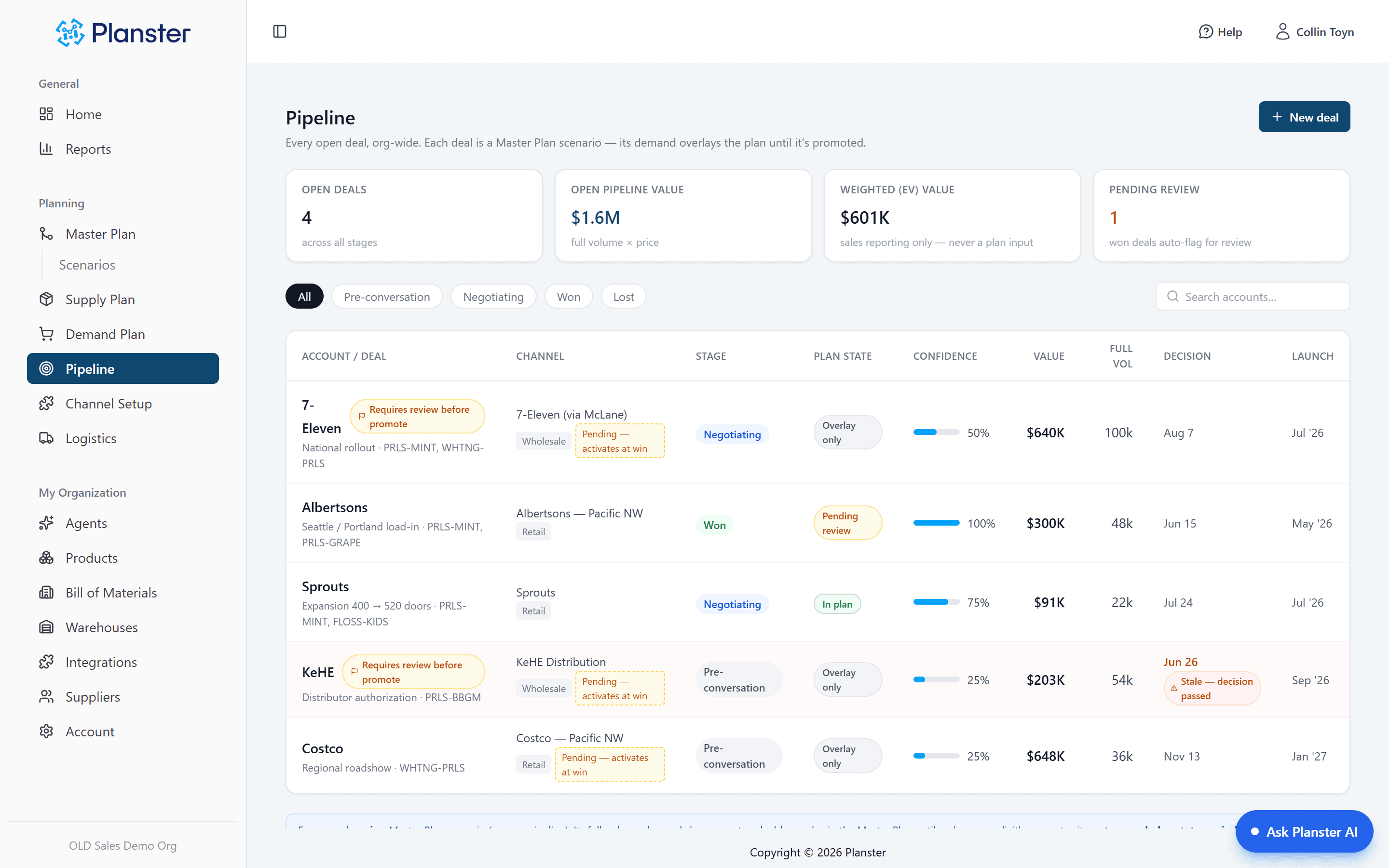
Pipeline puts retail deals in the demand plan where they belong. Every deal shows the week you have to place the order to hit the launch — and what you’re out if the deal dies.
A deal is a plan, not a promise
Every deal is one object with two lenses: sales sees the account, stage, and value; planning sees doors, fill orders, and weekly demand. No re-keying between a CRM and a spreadsheet. Change the deal and the demand changes with it.
Know exactly when to commit capital
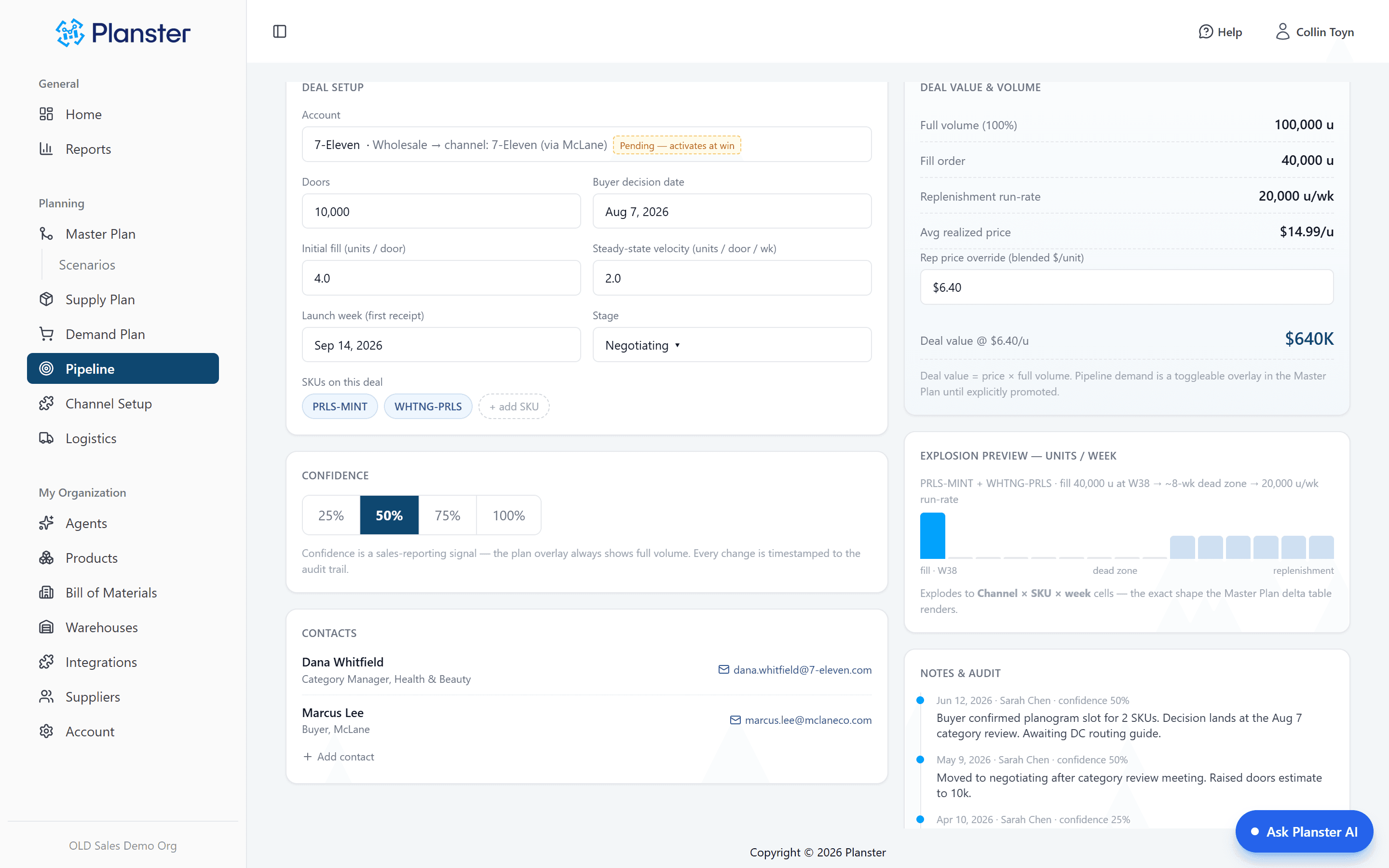
The decision window does the risk-buy math for you: order by week 29 to hit the week 38 launch — three weeks before the buyer even decides. And if you buy and the deal falls through: $82K committed, about nine weeks to burn it down at your current velocity. You decide. Planster makes the trade-off legible.
Full volume, clearly labeled
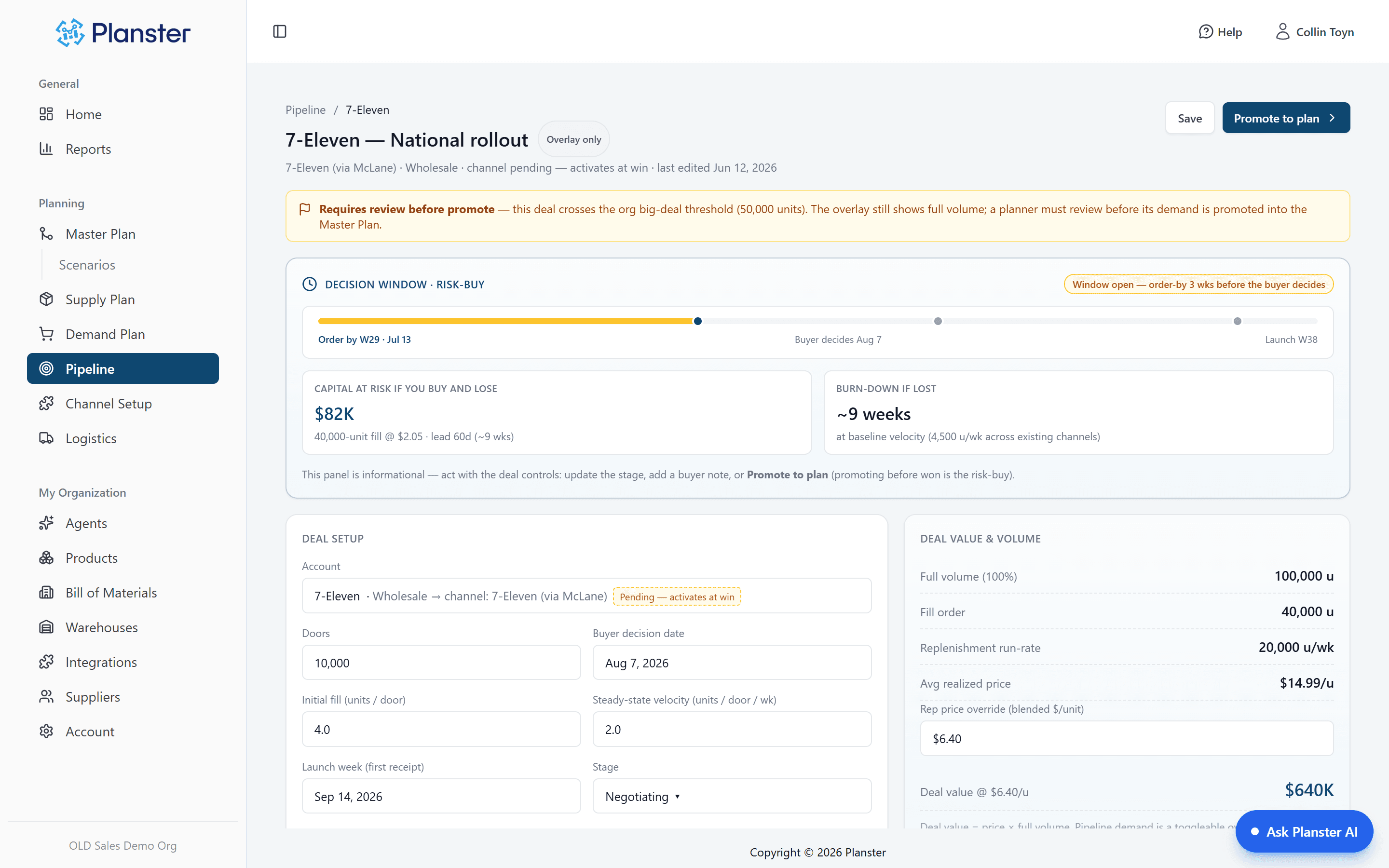
A 100,000-unit deal at 50% confidence is not a 50,000-unit order. Probability math is for sales reporting, not production planning. Deals overlay the Master Plan at full volume, visibly marked as unpromoted, so planners see the real magnitude of what might land.
Demand shaped the way retail actually behaves
A retail launch isn’t a smooth ramp. It’s a fill spike, a dead zone while shelves sell down, then a replenishment run rate. Planster explodes each deal into that shape, per channel, SKU, and week — the same grid your plan and your suppliers run on.
Your retailers are records, not rows
Door counts, rolling velocity, the products they carry, and the buyer’s contact details, kept with the deal instead of in someone’s phone. Per-store demand and last year’s numbers sit alongside, so you can tell real growth from more doors.
Nothing enters the plan silently
Deal stage and plan inclusion are separate decisions. Promoting demand into the Master Plan is always an explicit human step, and big deals get flagged for a planner’s review first.
What the agent does with pipeline
Every night
When the pipeline and the plan drift apart — a deal marked won that nobody promoted, an order-by date coming up on a deal still open — that is a ranked row in tomorrow morning’s list.
What it can’t do
It cannot promote a deal into the plan, change a deal’s stage, or commit capital against one. Every one of those is a human decision with a human’s name on it.
The 7-Eleven question every growing brand faces
A national rollout lands in the pipeline: 10,000 doors, launch in September, buyer decision in August. The catch is production lead time — you have to order in July, weeks before the buyer says yes. Planster shows the whole bet in one panel: order by week 29 to make the week 38 launch; if you buy and lose, $82K committed and about nine weeks to burn it down. The founder makes the call with both numbers in front of them, instead of finding the conflict in a spreadsheet three weeks too late.
How it fits together
Every capability runs on the same demand forecast, so each one makes the others more useful.
Master Plan
Promoted deals become versioned demand in your Master Plan, with the same consequence preview and undo as any other scenario.
Explore Master PlanKnow what’s comingRetail planning
The doors, facings, and per-retailer velocity a deal explodes into, kept as real retailer records.
Explore Retail planningStop planning launches in two systems
Put your deals where their consequences live. Book a demo and bring your gnarliest rollout.