Planster vs Settle
Settle is a strong AP-automation and inventory-financing platform that added planning. Planster is a purpose-built demand-planning platform for $10–50M consumable CPG — deep forecasting, scenario consequence previews, a retail-deal pipeline, and a proactive agent, with no loan book shaping the advice.
The short answer
No tool wins for everyone. Here's the honest split.
CPG brands who want deep, steerable demand planning — scenarios, a retail-deal pipeline, S&OP, and a proactive agent — with recommendations that aren't shaped by a lender.
Brands who primarily want bill-pay/AP automation and inventory financing in one place with clean UX, and treat demand planning as a secondary need.
Feature-by-feature
| Capability | Planster | Settle |
|---|---|---|
| Primary purpose | Demand planning — decide what to buy, when, and why | AP automation + inventory financing first; planning is a secondary add-on |
| Planning depth | Steerable forecasts, scenario planning, S&OP, reorder logic | Forecast auto-selects a model with no user-steerable surface; reviewers note it's "still developing" |
| Scenario planning with consequence preview | Sandbox what-ifs; capital preview before commit; version history + un-promote | None |
| Retail-deal pipeline → demand (risk-buy math) | Deals overlay the plan at full volume with order-by dates and capital-at-risk math | None |
| AI agent | Proactive overnight digest; draft POs with provenance | "Tally" is a copilot that can draft POs; not a proactive overnight agent |
| Inventory financing | Not a lender — plan in Planster, finance POs through any lender | Settle Working Capital lends $20K–$15M, often funded in under 48 hours |
| Advice independence | Recommendations aren't shaped by a loan book | Forecasting lives inside a lending business — recommendations may favor financed POs |
Where Planster pulls ahead
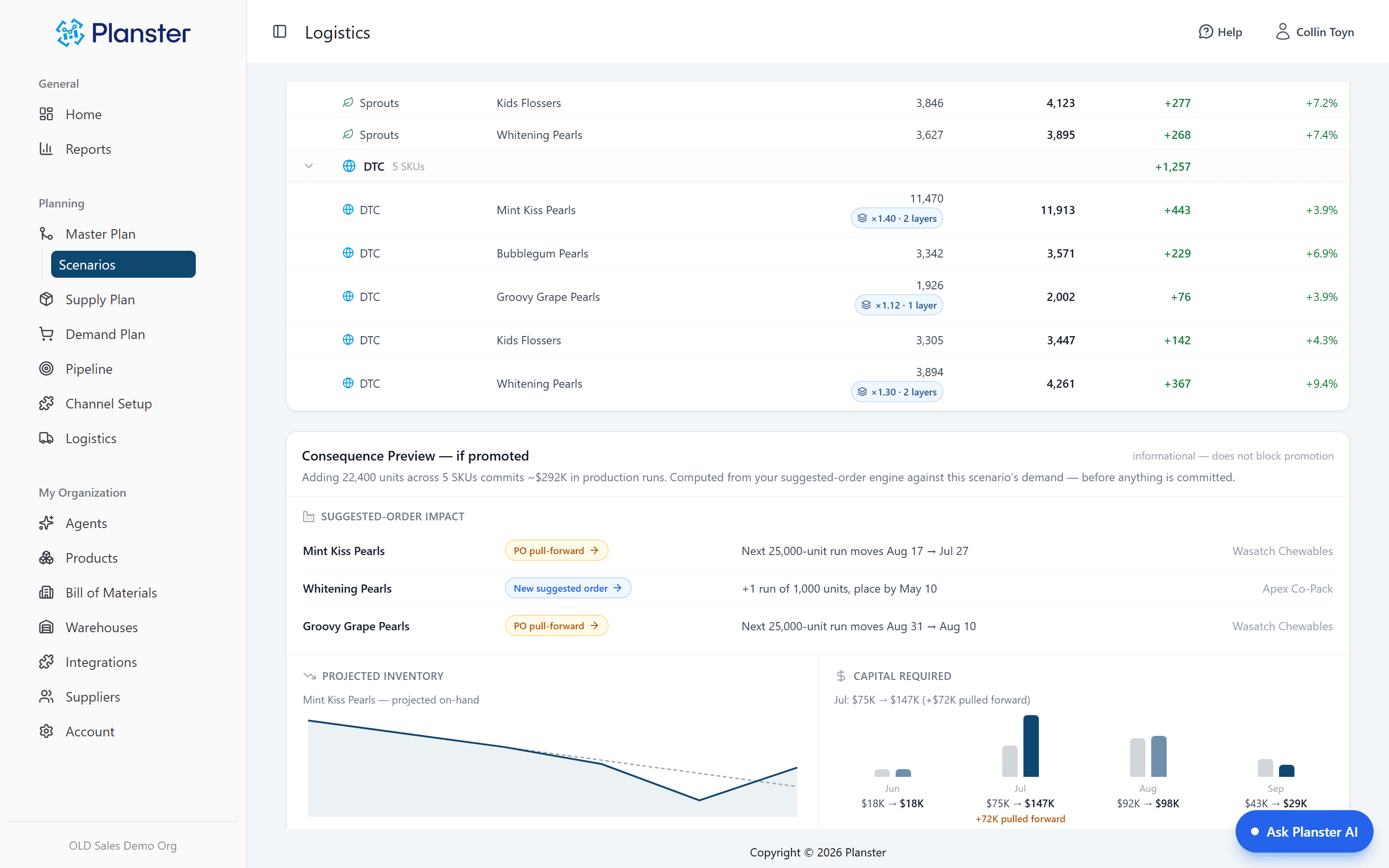
See what a decision costs before you commit
Planster's Master Plan runs every what-if through your real ordering engine and shows the consequence — which POs move and how much capital the change pulls forward — before you say yes. Most planning tools tell you what to reorder; Planster tells you what a whole scenario commits.
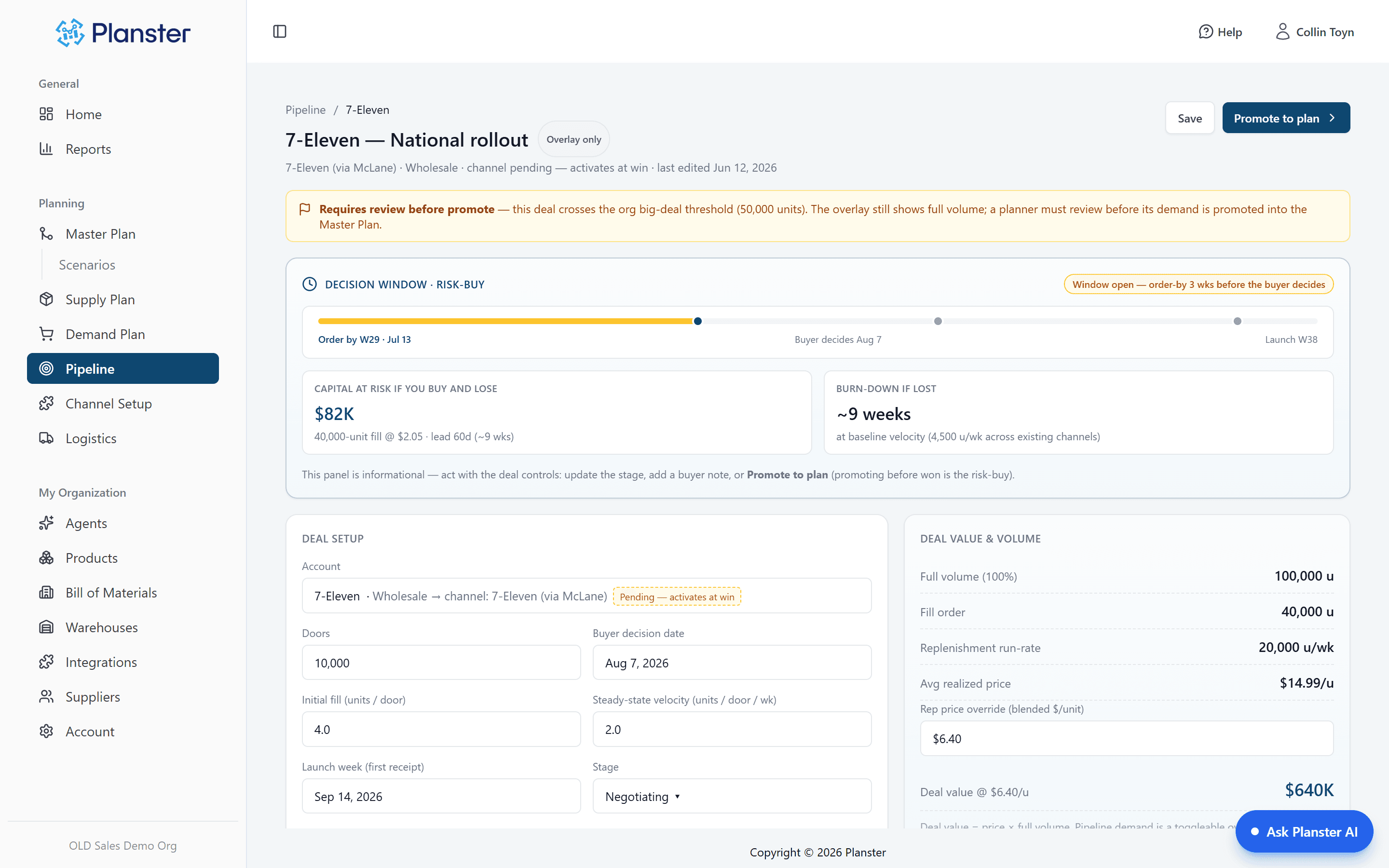
Plan the retail launch, not just the reorder
Planster's Pipeline treats retail deals as living demand: a deal overlays your plan at full volume and does the risk-buy math — the order-by date to hit the launch, and the capital at risk if it falls through. That founder-level "do I buy before the buyer decides?" question is one a reorder tool never answers.
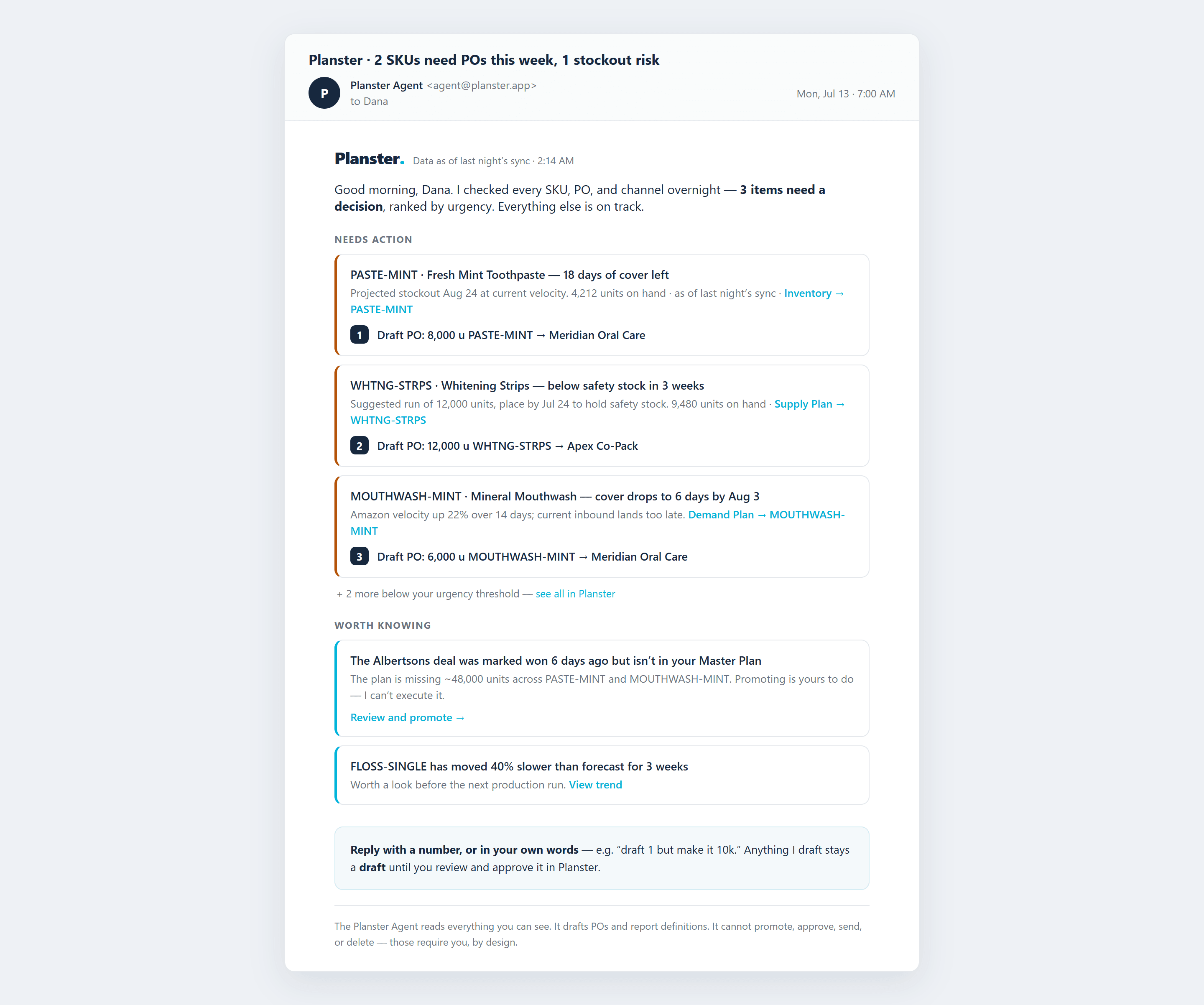
The checking happens overnight — the decision stays yours
Every night the Planster Agent checks every SKU, PO, and channel and emails a ranked morning digest with draft POs attached. You change what you want changed and approve in the app. It cannot promote, approve, or send on its own, and no setting changes that.
Pricing
Flat ~$1,000/month for planning, everything included.
SaaS tiers are cheap (Free / $199 / $499/mo) because the real monetization is financing — Settle Working Capital lends $20K–$15M at roughly 1.4%/month (~17% APR by their own example). Planster is flat $1,000/mo for planning, with no loan book behind the recommendations.
Settle pricing and financing terms verified against settle.com, 2026-07-23.
When Settle is the better fit
No tool wins for everyone. Here's where Settle is the honest choice.
- You mainly want AP automation and inventory financing (working capital, extended terms) in one platform.
- You value their clean UX and treat demand planning as a secondary need.
- You can plan in Planster and finance POs through Settle or any lender of choice.
Common questions
Can Planster finance my inventory like Settle?
No — Planster is a planning platform, not a lender. You plan in Planster and finance POs through your bank, Settle, or any lender. The upside: Planster's recommendations aren't shaped by a loan book, so the advice is about what's right for your inventory, not what's financeable.
Is Settle's demand planning as deep as Planster's?
Settle's forecasting is newer and auto-selects a model with no user-steerable planning surface — their own reviewers note the inventory features are "still developing." Planster is purpose-built for demand planning, with scenarios, S&OP, and a retail-deal pipeline.
Planning first, financing wherever you like
See demand planning built to decide what to buy — with no lender shaping the recommendation.