Planster vs Netstock
Netstock is a mature planning layer that sits on top of an ERP and reads it — 60+ of them, deeply. Planster is built for $10–50M consumable CPG brands that never bought an ERP, and reads the cart, WMS and 3PL directly instead. That one architectural difference decides most of this comparison.
The short answer
No tool wins for everyone. Here's the honest split.
$10–50M consumable CPG brands running Shopify, Amazon, a 3PL and a spreadsheet — no ERP to read, and no appetite for buying one to get a planning tool.
Businesses already running one of the 60+ ERPs Netstock integrates with — particularly SAP Business One, Acumatica, SYSPRO or Microsoft Dynamics — and distribution or manufacturing operations well outside consumable CPG.
Feature-by-feature
| Capability | Planster | Netstock |
|---|---|---|
| Does it need an ERP? | No. Sales and inventory sync through Trackstar — 150+ WMS, 3PL, cart and marketplace systems | Yes. Purpose-built to read an ERP; 60+ supported, and it is the system of record it plans from |
| ERP depth where you do have one | Zoho and Luminous native today; QuickBooks Online, Xero, NetSuite and Sage rolling out | 60+ ERPs including SAP Business One, Acumatica, SYSPRO, Microsoft Dynamics and MYOB |
| Time to first plan | Days — connect the cart and warehouse, and the first ranked list lands on day one | Implementation "typically requires 6-10 weeks" per their own pricing page |
| Scenario planning with consequence preview | Sandbox a promo or launch over live demand; see the capital it commits before promoting; un-promote to undo | Not described anywhere on their site |
| Retail-deal pipeline → demand (risk-buy math) | Deals overlay the plan at full volume with order-by dates and capital-at-risk math | Not described anywhere on their site |
| Supplier performance monitoring | Lead times feed ordering, but there is no dedicated supplier-performance module | Supplier Performance is a named module |
| AI | Overnight scan of every SKU, PO and channel → ranked morning digest with draft POs attached | An "AI Pack" with an Opportunity Engine surfacing insights; no PO drafting described |
| Pricing | Flat $1,000/month, everything included | "Pricing starts at $900/month", annual, with the final number depending on the bundle you select |
Where Planster pulls ahead
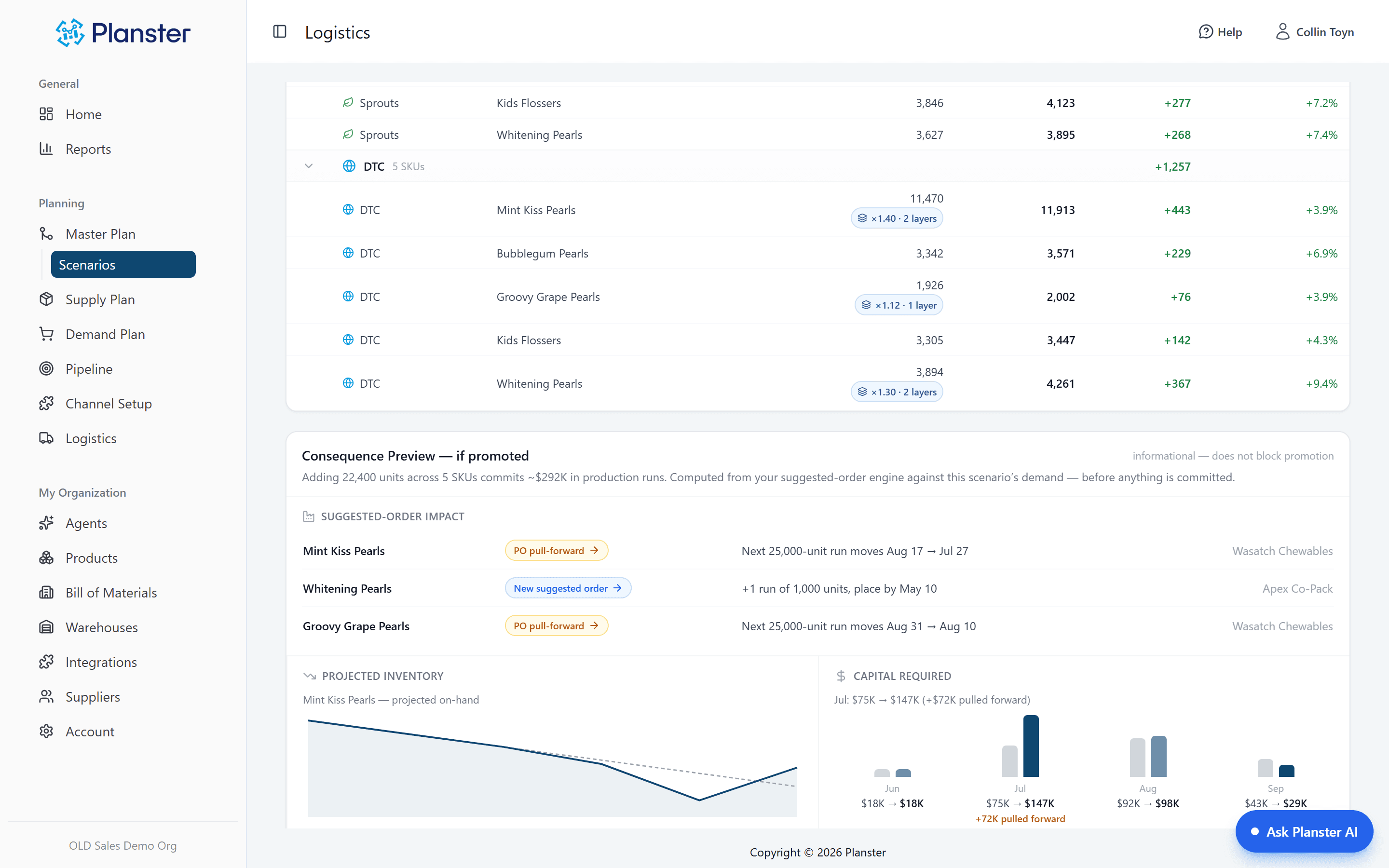
See what a decision costs before you commit
Planster's Master Plan runs every what-if through your real ordering engine and shows the consequence — which POs move and how much capital the change pulls forward — before you say yes. Most planning tools tell you what to reorder; Planster tells you what a whole scenario commits.
Plan the retail launch, not just the reorder
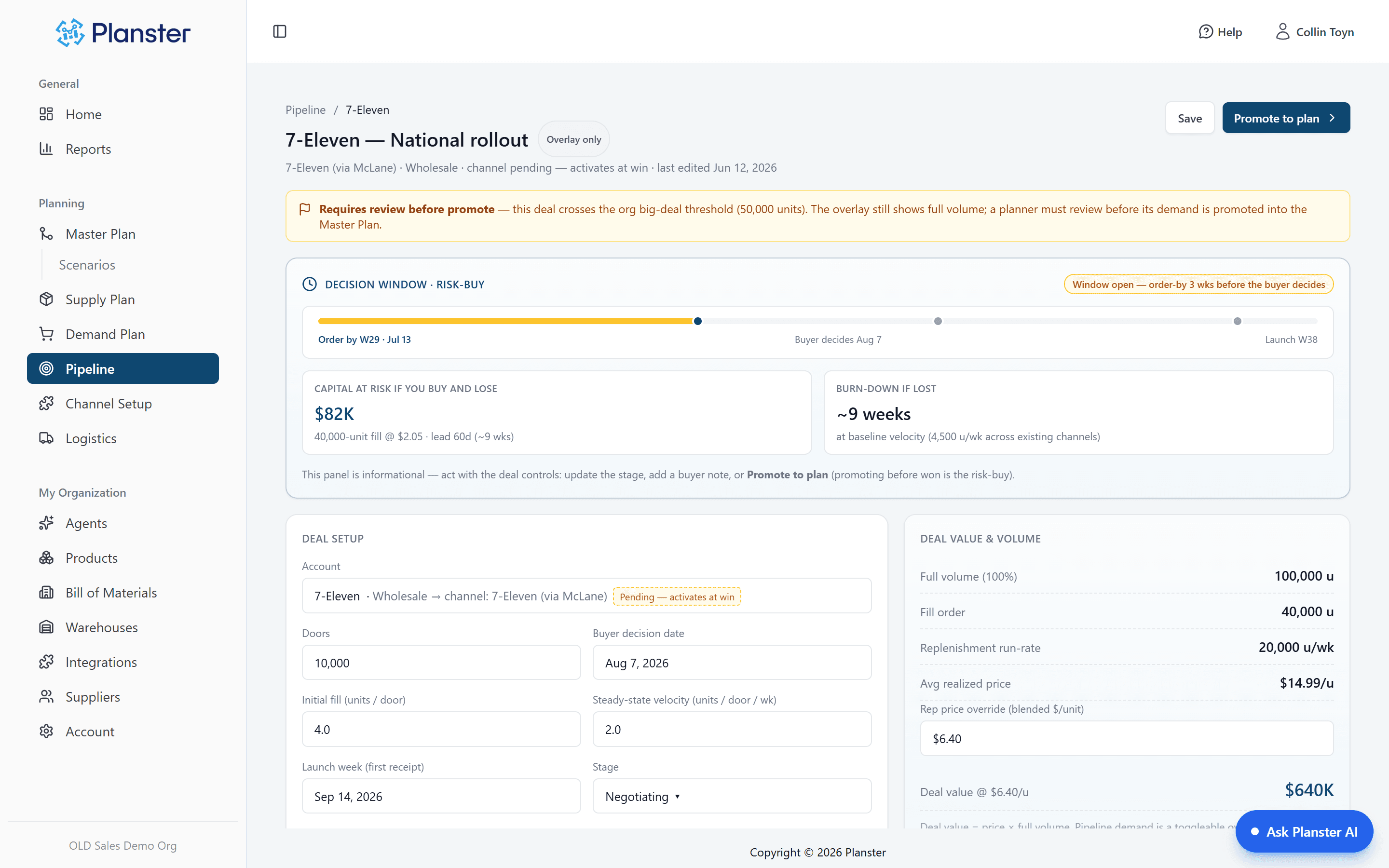
Planster's Pipeline treats retail deals as living demand: a deal overlays your plan at full volume and does the risk-buy math — the order-by date to hit the launch, and the capital at risk if it falls through. That founder-level "do I buy before the buyer decides?" question is one a reorder tool never answers.
The checking happens overnight — the decision stays yours
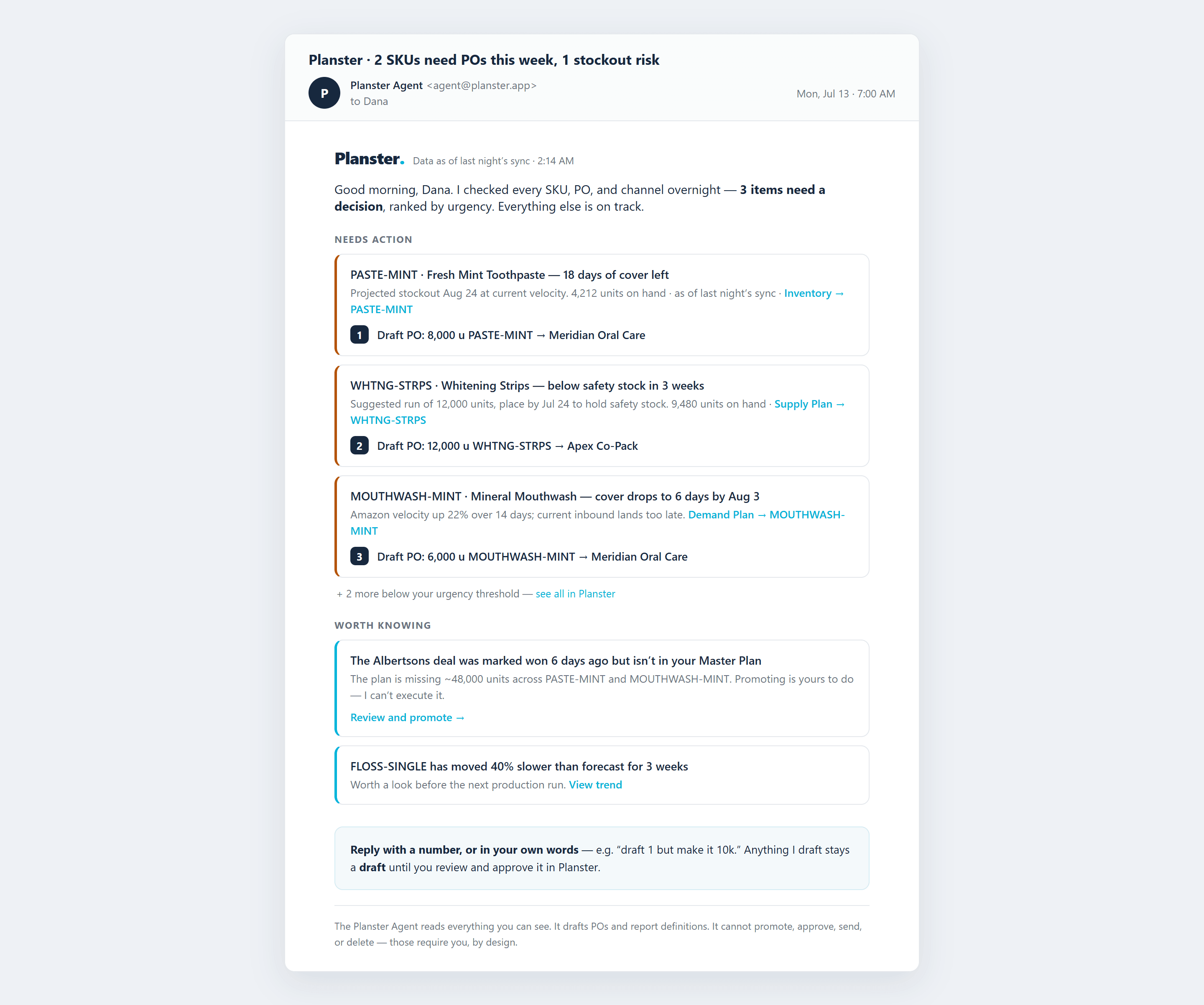
Every night the Planster Agent checks every SKU, PO, and channel and emails a ranked morning digest with draft POs attached. You change what you want changed and approve in the app. It cannot promote, approve, or send on its own, and no setting changes that.
Pricing
Flat $1,000/month, everything included. One number, and it does not change as you grow.
Netstock states pricing "starts at $900/month" on an annual subscription, with the final figure depending on the product and bundle. The two entry points are close enough that price is not the deciding factor here — predictability is. Planster publishes one number that covers everything; Netstock publishes a floor.
Netstock pricing and the 6-10 week implementation window verified against netstock.com/pricing, 2026-08-10. See marketing-brain/competitor-research/netstock.md.
When Netstock is the better fit
No tool wins for everyone. Here's where Netstock is the honest choice.
- You already run an ERP — especially SAP Business One, Acumatica, SYSPRO, Microsoft Dynamics or MYOB. Netstock reads your system of record directly, and Planster does not integrate with those.
- You need supplier performance monitoring as a dedicated module. Netstock has one; Planster does not.
- You are a distributor or manufacturer rather than a consumable CPG brand. Netstock spans automotive, healthcare, industrial and wholesale; Planster is built for one segment on purpose.
- Your planning problem is ERP data quality rather than channel complexity. That is the problem Netstock was designed for.
Common questions
Do you need an ERP to use Netstock?
Yes. Netstock describes itself as purpose-built to integrate with over 60 leading global ERP systems, converting ERP data into planning insights, and the ERP is the system of record it plans from. That is a good architecture if you already have one. Most $10–50M consumable CPG brands do not — they run a cart, a 3PL portal and a spreadsheet — which is why Planster reads those systems directly through Trackstar instead of requiring an ERP underneath.
Is Netstock cheaper than Planster?
Netstock states that pricing starts at $900/month on an annual subscription, with the final figure depending on the product and bundle selected. Planster is a flat $1,000/month with everything included. The published entry points are close enough that price should not decide this comparison. The real difference is predictability: Planster publishes one number that covers every feature and every user, while Netstock publishes a floor and prices the rest by bundle.
How long does Netstock take to implement?
Netstock's own pricing page states that implementation typically requires 6 to 10 weeks, varying with data complexity, business size and the specifics of your ERP. Planster is usually running in days, because there is no ERP mapping step — sales and inventory sync automatically through Trackstar and the first ranked list of decisions arrives on day one. If you are replacing a tool mid-season, that difference is the whole decision.
No ERP? That is not a gap to close first.
Connect the cart and the warehouse. The first ranked list of what to order lands on day one.