Planster vs Luminous
Luminous is an operations platform: inventory, warehouse, orders, embedded EDI, invoicing and bills in one system of record, with a Claude connector that can write to it. Planster is demand and supply planning software for $50–500M consumable CPG brands, manufacturers and co-manufacturers. It forecasts every SKU across retail, wholesale, DTC and Amazon, turns that forecast into a ranked list of what to order and when, and shows what a scenario commits before you approve it. Luminous runs the operation; Planster plans it.
Luminous details last reviewed
The short answer
No tool wins for everyone. Here's the honest split.
$50–500M consumable CPG brands, manufacturers and co-manufacturers that already have a system holding the stock and the orders, and want a forecast with a named method, scenarios that show the purchase orders and cash they commit, and retail deals in the plan at full volume, at a published price.
Brands that need one system of record for stock, warehouses, orders, EDI, invoicing and bills, with lot and expiry tracking, a hands-on 60-day implementation and an AI connector that can create POs and update orders inside the platform.
Feature-by-feature
| Capability | Planster | Luminous |
|---|---|---|
| What it is | Demand and supply planning software. The output is a decision: what to order, when and how much | An operations platform covering inventory, demand forecasting, COGS, multi-warehouse management, WMS, lite manufacturing, a B2B portal, automated invoicing and embedded EDI. It positions itself against ERPs: "Most ERPs Take 12 Months. Luminous Gets You Live in 60 Days." (joinluminous.com, 2026-10-22) |
| Who it is written for | The operations team at a $50–500M consumable CPG brand, manufacturer or co-manufacturer: VP of operations, planners, purchasing | "Modern Commerce Brands", in three tiers by revenue band starting at $5M and running to $50M+. No industry is named on its pages (joinluminous.com, 2026-10-22) |
| Forecasting method, published | One forecast per SKU, with the model chosen per SKU from Prophet, ETS, SARIMA and linear regression; seasonality detection, stockout periods excluded from the fit, and alerts when a SKU runs outside its tolerance | No model is named. Customers can "Import the formulas that work for you into Luminous, or tweak them"; sales-velocity logic is set during implementation, and seasonality can be embedded "if needed" (joinluminous.com/demand-planning, 2026-10-22) |
| Ordering | Every SKU's upcoming orders worked out from on-hand inventory, target levels, safety stock in days of cover and supplier lead times, ranked by due date, with MOQs and container quantities applied | "Luminous recommends purchase quantities based on your preferred buffer stock, days on hand threshold", with alerts when a SKU's sales spike and a replenishment flow across warehouses (joinluminous.com/demand-planning, 2026-10-22) |
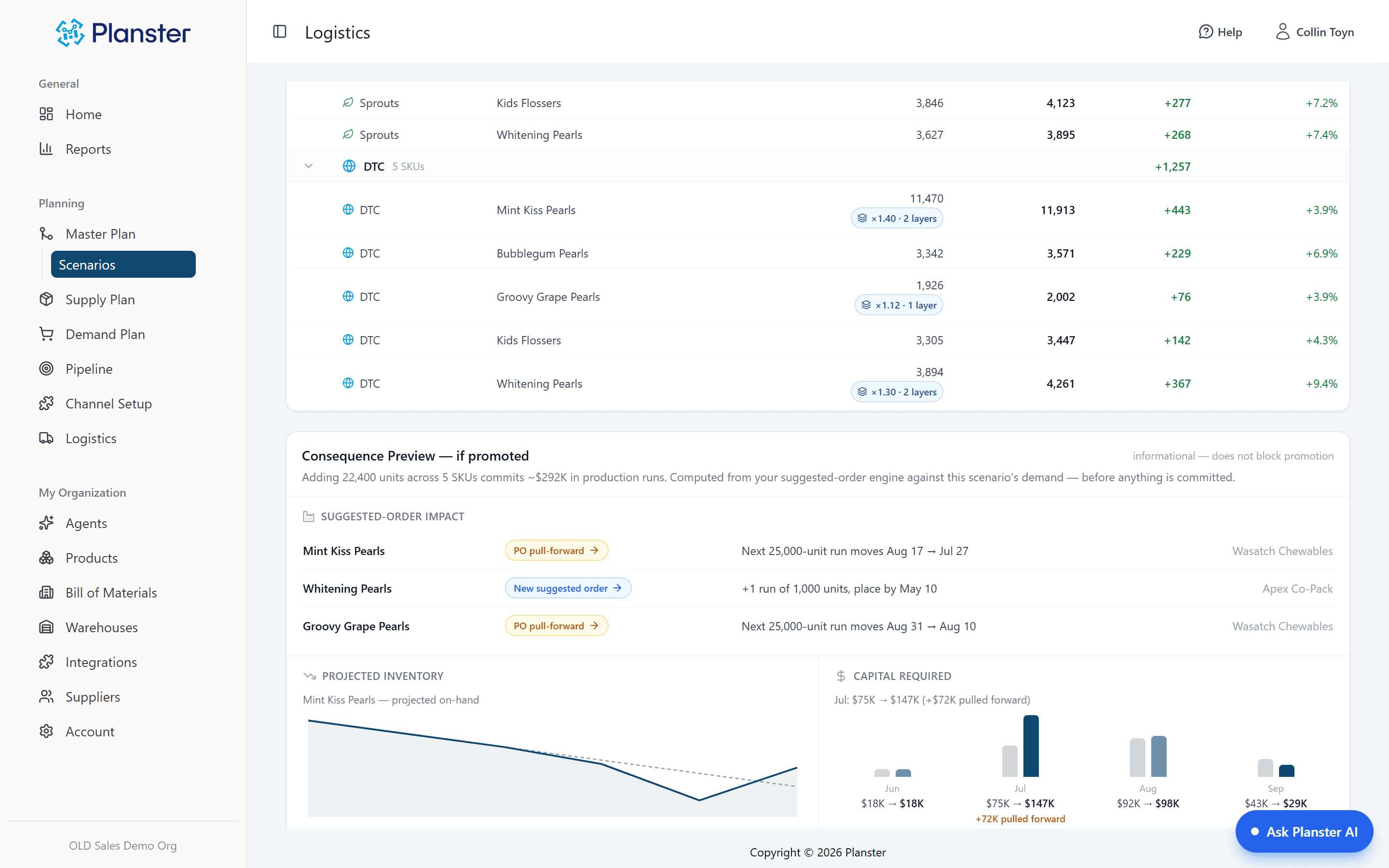
| Scenario planning with a cost preview | Master Plan runs a scenario through the same ordering calculation as the live plan: which POs move and the cash it commits (~$292K in the standard example). Approving one writes a version you can roll back | We could not find scenario planning on the demand-planning page or in the release notes (checked 2026-10-22) |
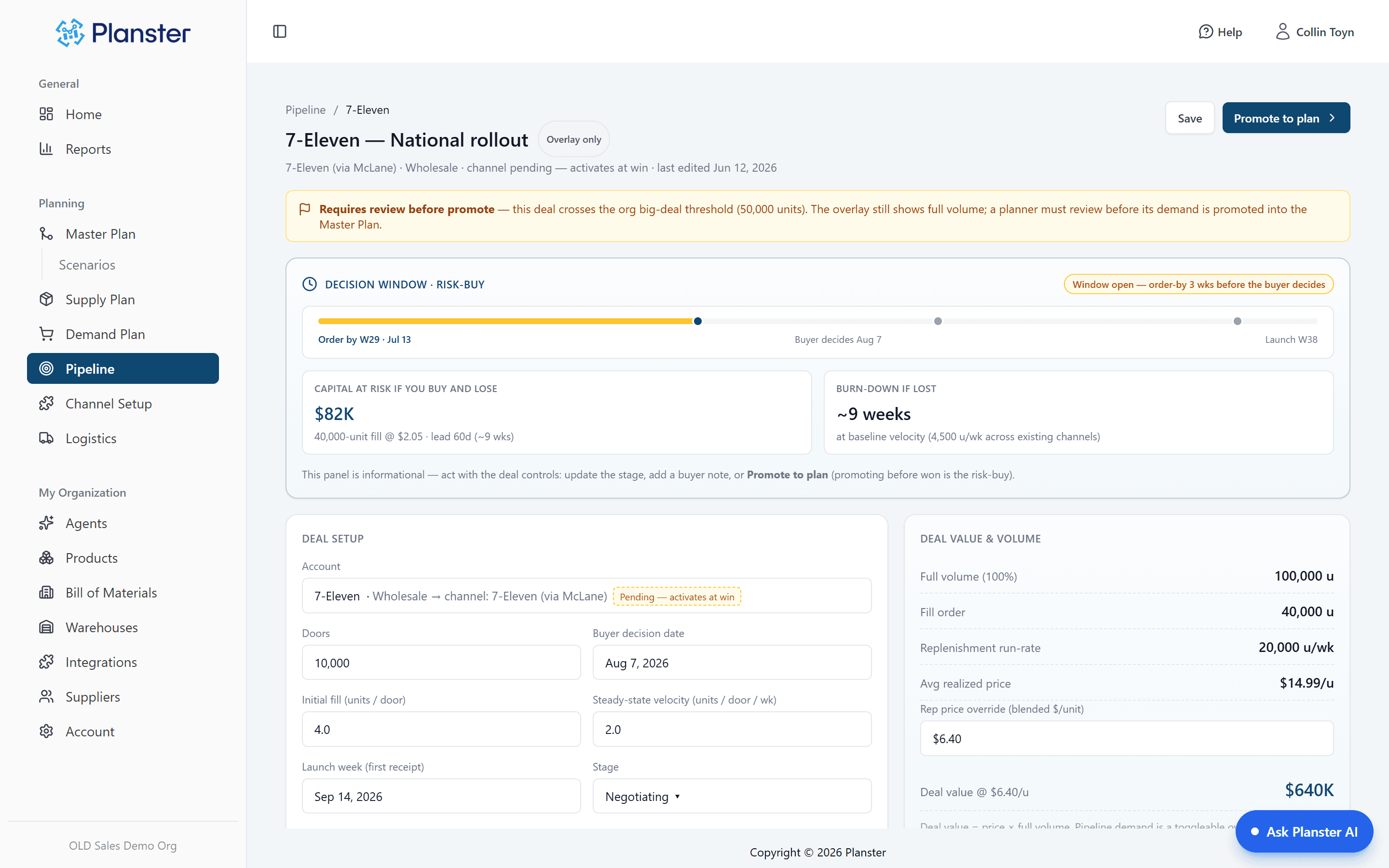
| Retail deals in the plan | Pipeline adds each retail deal to the plan at full volume, as the fill order, the gap after it and the replenishment run-rate, with an order-by date and the cash at risk if the deal falls through. Retail is forecast from doors and velocity per retailer | Plans "both wholesale and DTC restocking" from historical sales across channels. We could not find a deal or pipeline feeding demand; HubSpot is listed as an integration with no forecasting use described (checked 2026-10-22) |
| Warehouse, orders and EDI | Not offered. Planster reads stock and orders from the systems that hold them; it is not a WMS, an OMS or an EDI provider | WMS and 3PL plug-in, transfers between locations, a B2B portal and embedded EDI covering "receiving POs, sending ASNs, and pushing to a fulfillment status", with no charge per transaction (joinluminous.com, 2026-10-22) |
| Lot and expiry tracking | Not offered. No lot tracking, shelf life or expiry dates | "You can input an expiration date and a lot ID", and a finished good can be traced back to the lot IDs of its components (joinluminous.com/inventory-management, 2026-10-22) |
| Stock sync to sales channels | Reads connected systems on a nightly sync. It does not push stock levels to sales channels | Virtual stock calculated "less than every minute" and pushed back to sales channels (joinluminous.com/inventory-management, 2026-10-22) |
| Accounting | Not offered. No invoicing, bills or landed-cost accounting | Automated invoicing, QuickBooks sync, and from July 2026 bills with three-way matching and automated landed costs (joinluminous.com, 2026-10-22) |
| Manufacturing and co-manufacturers | Bills of materials: see when runs are needed and what materials each requires, and plan shared raw materials in one place. Also used for finished-goods kitting | BOMs, work orders and multi-level sub-assemblies with manufacturing traceability, plus a Co-Manufacturing Coordination Module shipped July 2026 for raw materials, packaging, labels and production runs at a co-manufacturer (joinluminous.com, 2026-10-22) |
| Integrations | 150+ through Trackstar, including 154 WMS, 3PL and fulfillment systems and 17 carts and marketplaces. Planster integrates with Luminous | Shopify, Amazon, ShipStation, QuickBooks, Etsy, TikTok Shop, HubSpot, Lightspeed, Shopify POS and Square named; no count claimed (joinluminous.com/integrations, 2026-10-22) |
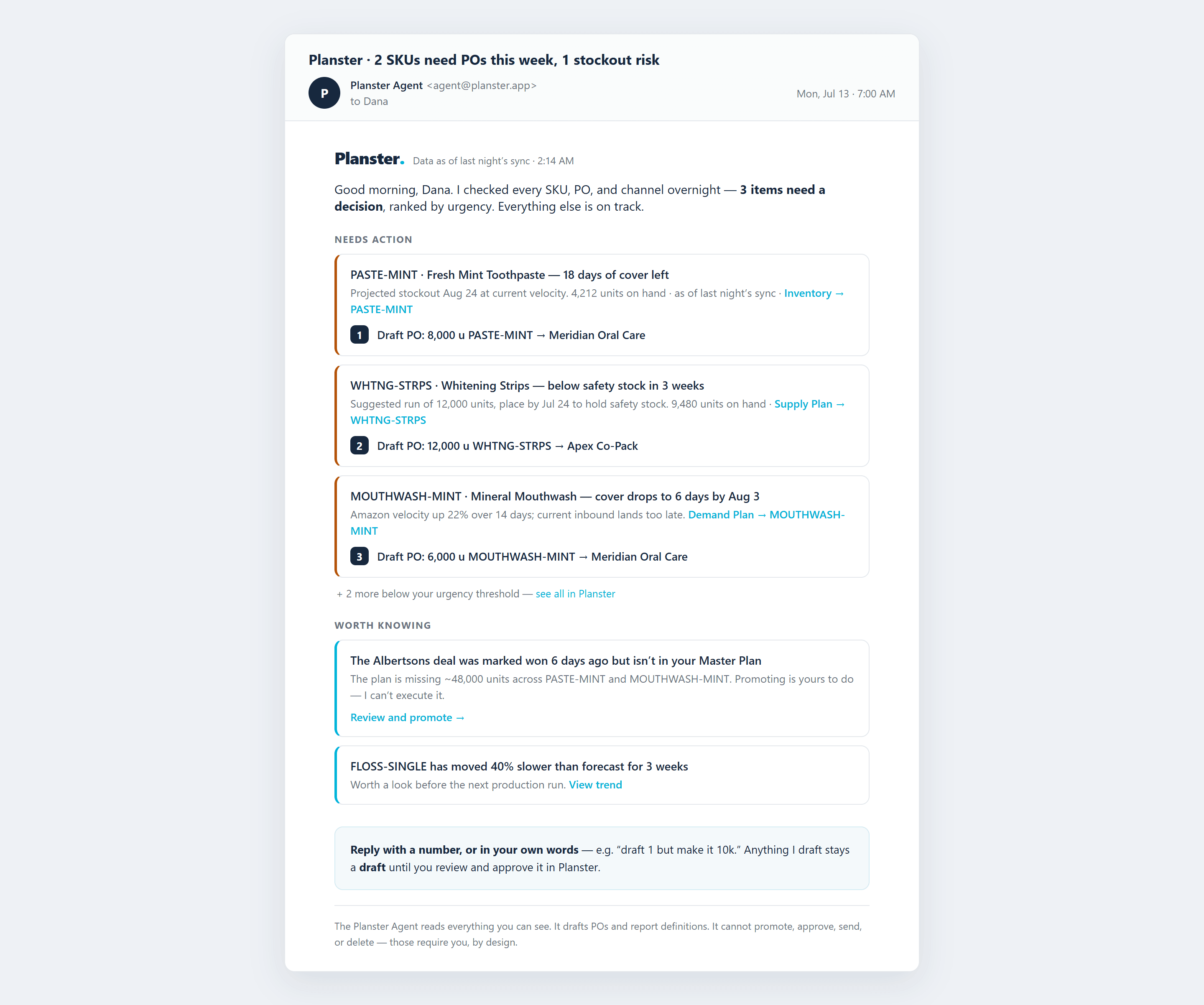
| AI | Built on the forecast and the order calculation: a nightly check of every SKU, PO and channel, a ranked morning digest, and the POs drafted in the app for your team to approve. It cannot approve an order, send to a supplier, promote a plan or delete, and no setting changes that | A Claude connector (MCP), labelled "Read + write": "Create POs, allocate inventory, update orders without touching another tab", plus automations built from a plain-English description. Whether there is a confirmation step is not published (joinluminous.com/claude, 2026-10-22) |
| Implementation | Software you connect to the systems you already run | "Luminous Gets You Live in 60 Days", with a dedicated implementation team that fully migrates your data and stays on for support (joinluminous.com/implementation, 2026-10-22) |
| Reporting | Custom only. Build any report you need, and the agent can draft the definition. There is no prebuilt report library | An analytics and automations module, plus replenishment reports across warehouses (joinluminous.com, 2026-10-22) |
| Pricing | Pilot $99/month, Plan $999/month, Produce $2,499/month, published, with unlimited users | Not published. All three tiers read "Custom Pricing", described as "one flat, all-in price" (joinluminous.com/pricing, 2026-10-22) |
| How you start | A free agent on one integration or a file upload, with no call to book; Pilot at $99/month above it | No trial is published; the Enterprise tier is through sales (joinluminous.com/pricing, 2026-10-22) |
Where Planster pulls ahead
See what a decision costs before you commit
Planster's Master Plan runs every scenario through the same ordering calculation as your live plan and shows which POs move and how much cash the change pulls forward, before anyone approves it. Most planning tools tell you what to reorder; Planster also shows what a whole scenario commits.
Plan the retail launch, not just the reorder
Planster's Pipeline puts retail deals into the demand plan at full volume and calculates the order-by date to make the launch and the cash at risk if the deal falls through. Whether to buy before the buyer decides is a question a reorder tool does not answer.
Checks run overnight; decisions stay with your team
Every night Planster checks every SKU, PO and channel and emails a ranked morning digest with draft POs attached. Your team changes what it wants changed and approves in the app. It cannot approve a plan or an order, or send anything, on its own, and no setting changes that.
Pricing
Pilot $99/month, Plan $999/month, Produce $2,499/month, with unlimited users on every tier. Plan, the full app, is $999/month. All three prices are on the pricing page.
Luminous publishes no price. Its pricing page shows three tiers by revenue band, Lite, Professional and Enterprise, each marked "Custom Pricing", and describes the model as "one flat price—no surprise add-ons". Its EDI page says it does not charge for data or per transaction (joinluminous.com, 2026-10-22). This page does not estimate a Luminous price and does not claim Planster costs less. Both companies describe a single price; the difference is that Planster publishes its three, and Luminous quotes.
Every Luminous fact on this page is sourced to joinluminous.com, accessed 2026-10-22, in marketing-brain/competitor-research/luminous.md. Next review 2027-01-22.
When Luminous is the better fit
No tool wins for everyone. Here's where Luminous is the honest choice.
- You need a system of record, not a planning layer. Luminous runs the warehouse, orders, transfers between locations, the B2B portal, invoicing, bills and landed costs. Planster does none of that and reads those numbers from somewhere else.
- You sell to retailers over EDI and want it inside the same system. Luminous embeds EDI, from receiving POs to sending ASNs, with no per-transaction charge. Planster is not an EDI system.
- You need lot and expiry tracking. Luminous records lot IDs and expiration dates and traces a finished good back to its component lots. Planster tracks neither.
- You want an AI that writes into your operations system. Through its Claude connector, Luminous can create POs, allocate inventory and update orders. Planster's agent only drafts; a person approves every order in the app.
- You want a vendor to implement it for you. Luminous promises go-live in 60 days with a dedicated team that migrates your data and stays on for support.
- You coordinate materials, packaging and labels with a co-manufacturer and want that in your operations system. Luminous shipped a module for it in July 2026, alongside BOMs and work orders.
- You are under $50M and want one vendor for operations. Luminous's tiers start at $5M in revenue; Planster is built for $50M and up.
Common questions
Is Luminous an ERP?
Luminous positions itself as an alternative to one. Its implementation page says "Most ERPs Take 12 Months. Luminous Gets You Live in 60 Days.", and its site compares it with NetSuite, Cin7, Fishbowl, Extensiv, Odoo and Fulfil.io (joinluminous.com, accessed 2026-10-22). In practice it is an operations platform that holds inventory, warehouse, orders, EDI, invoicing and bills. Planster is not that kind of system. It is a planning layer that reads those numbers and tells the operations team what to order and when.
How does Luminous forecast demand?
Luminous does not name a forecasting model on its demand-planning page. It says customers can import the formulas that work for them or tweak them, that sales-velocity logic is set during implementation, and that it recommends purchase quantities from a preferred buffer stock and days-on-hand threshold (joinluminous.com/demand-planning, accessed 2026-10-22). That is a difference in what each company publishes, not a claim about what Luminous can do. Planster publishes its method: Prophet, ETS, SARIMA and linear regression, tested against each SKU's history and chosen per SKU.
How much does Luminous cost?
Luminous does not publish a price. Its pricing page lists Lite, Professional and Enterprise tiers by revenue band, each marked "Custom Pricing", and describes one flat, all-in price with no surprise add-ons (joinluminous.com/pricing, accessed 2026-10-22). Planster publishes three tiers: Pilot at $99/month, Plan at $999/month and Produce at $2,499/month, with unlimited users on every tier. To compare cost, request a Luminous quote and set it against those prices.
Does Luminous have an AI agent?
Luminous offers a Claude connector (MCP), labelled read and write, that can create POs, allocate inventory and update orders, and it builds automations from a plain-English description (joinluminous.com, accessed 2026-10-22). The customer brings Claude, and Claude acts inside Luminous. Planster's agent sits on its own forecast and order calculation: every night it checks every SKU, purchase order and channel, sends a ranked morning digest, and leaves the purchase orders drafted in the app. It cannot approve an order or send anything to a supplier.
Does Luminous work with co-manufacturers?
Yes. In July 2026 Luminous shipped a Co-Manufacturing Coordination Module for brands coordinating raw materials, packaging and labels with a co-manufacturer, managing production runs or individual work orders from one page and tracking COGS through them (joinluminous.com/feature-drops, accessed 2026-10-22). It also supports BOMs, work orders and multi-level sub-assemblies. Luminous describes its manufacturing as a fit for lean production processes rather than complex multi-stage work orders.
Can you use Planster and Luminous together?
Yes. Planster integrates with Luminous, so a brand can keep Luminous as the system of record for stock, warehouses, orders and EDI and use Planster to plan on top of it: the forecast, the scenarios, retail deals and the ranked list of what to order. Luminous stays the place orders are fulfilled and invoiced; Planster is where the team decides what to buy.
Plan on top of the system that runs your operation
Planster builds one forecast per SKU, shows what a scenario commits before you approve it, and ranks what to order, with the purchase orders drafted for your team.