Planster vs Katana
Katana is cloud inventory and production management software: the system of record for stock, sales orders, purchase orders, manufacturing orders and outsourced production, with batch and expiry tracking and a 12-month replenishment forecast. Planster is demand and supply planning software for $50–500M consumable CPG brands, manufacturers and co-manufacturers. It forecasts every SKU across retail, wholesale, DTC and Amazon, turns that forecast into a ranked list of what to order and when, and shows what a scenario commits before you approve it. Katana records what you have and what you are making; Planster decides what you should order next.
Katana details last reviewed
The short answer
No tool wins for everyone. Here's the honest split.
$50–500M consumable CPG brands, manufacturers and co-manufacturers that need one demand plan across every channel, with retail deals in it at full volume, scenarios that show the purchase orders and cash they commit, and a forecast on every SKU with a named method, at a published price.
Product businesses that need a system of record for inventory, manufacturing orders, outsourced purchase orders, recipes and batch and expiry tracking, with a genuinely free plan for up to 30 SKUs, an AI connector that can write to those records, and implementation and 24/7 support bundled on its Advantage plan.
Feature-by-feature
| Capability | Planster | Katana |
|---|---|---|
| What it is | Demand and supply planning software. The output is a decision: what to order, when and how much | "Cloud inventory and production management software for product businesses": inventory by location and bin, sales orders, purchase orders, manufacturing orders, outsourced purchase orders and BOMs as native records (katanamrp.com, 2026-10-22) |
| Who it is written for | The operations team at a $50–500M consumable CPG brand, manufacturer or co-manufacturer: VP of operations, planners, purchasing | "Small and mid-sized businesses that have outgrown spreadsheets", 1,500+ of them across 70 countries. Industries named include food and beverage, cosmetics, coffee roasting and pharmaceuticals. No revenue band is published (katanamrp.com, 2026-10-22) |
| Forecasting method and coverage | A forecast for every SKU, with the model chosen per SKU from Prophet, ETS, SARIMA and linear regression; seasonality detection, stockout periods excluded from the fit, and the forecast kept current automatically as data syncs | Katana forecasts. Planning and forecasting projects demand per product from sales history and current trends, and AI Replenishment gives "a 12-month forecast and a ready-to-approve order" with seasonality, safety stock and a reorder point. AI Replenishment runs on a selection: "Pick a SKU, or up to 50". No model is named (katanamrp.com, 2026-10-22) |
| One plan across channels, with retail deals in it | Each channel planned separately and as one combined plan. Pipeline adds each retail deal at full volume, as the fill order, the gap after it and the replenishment run-rate, with an order-by date and the cash at risk if the deal falls through. Retail is forecast from doors and velocity per retailer | Forecasts are built from sales history across the channels Katana connects. HubSpot, Salesforce, Pipedrive and Prospect CRM are listed as integrations; Katana's pages describe no use of a CRM deal in the forecast (katanamrp.com, 2026-10-22) |
| Scenario planning with a cost preview | Master Plan runs a whole scenario through the same ordering calculation as the live plan: which POs move and the cash it commits (~$292K in the standard example). Approving one writes a version you can roll back | AI Replenishment shows minimum, recommended and maximum order scenarios for each selected SKU, each "explained in plain language" (katanamrp.com/features/ai-replenishment, 2026-10-22) |
| Ordering | Every SKU's upcoming orders worked out from on-hand inventory, target levels, safety stock in days of cover and supplier lead times, ranked by due date, with MOQs and container quantities applied | Suggested reorder dates and quantities from forecasts, stock, supplier lead times and MOQs; AI Replenishment converts its recommendation into a draft PO or manufacturing order that goes through Katana's approval flow (katanamrp.com, 2026-10-22) |
| Manufacturing orders and MRP | Bills of materials: see when runs are needed and what materials each requires, and plan shared raw materials in one place. Planster does not hold manufacturing orders as the record | Make-to-order and make-to-stock manufacturing orders with priorities, material availability checked per order, recipe management and material requirements planning (katanamrp.com, 2026-10-22) |
| Contract manufacturing | Records purchase orders and tracks them through delivery. It does not track materials sitting at a co-manufacturer | Outsourced purchase orders: send part or all of production to a contractor, transfer or buy materials into the contractor's location, and receive the finished goods (support.katanamrp.com, 2026-10-22) |
| Batch, expiry and traceability | Not offered. No lot tracking, shelf life or expiry dates | "Batch and expiry date tracking are built into Katana", with finished goods traced to ingredient batches for recalls (katanamrp.com/industries/food-beverage, 2026-10-22) |
| Integrations | 150+ through Trackstar, including 154 WMS, 3PL and fulfillment systems and 17 carts and marketplaces. Planster does not connect to Katana today | Shopify, WooCommerce, BigCommerce, Amazon and eBay; QuickBooks Online and Xero; ShipStation, ShipHero, Mintsoft and ShipBob; HubSpot, Salesforce, Pipedrive and Prospect CRM; Zapier and an open API. No count is claimed (katanamrp.com/integrations, 2026-10-22) |
| AI | Built on the forecast and the order calculation: a nightly check of every SKU, PO and channel, a ranked morning digest, and the POs drafted in the app for your team to approve. It cannot approve an order, send to a supplier, promote a plan or delete, and no setting changes that | Katana MCP lets Claude or ChatGPT read, create and update inventory, sales orders, manufacturing orders, POs, products and BOMs, with no delete; Katana advises asking the AI "to outline the change before confirming". Plus AI Replenishment and an AI Assistant (katanamrp.com, 2026-10-22) |
| Reporting | Custom only. Build any report you need, and the agent can draft the definition. There is no prebuilt report library | Custom reports, integrations and automations built for you on the Advantage plan (katanamrp.com/pricing, 2026-11-03) |
| Pricing | Pilot $99/month, Plan $999/month, Produce $2,499/month, published, with unlimited users | Free at $0 for up to 30 SKUs, and Advantage on custom pricing under an annual contract (katanamrp.com/pricing, 2026-11-03) |
| How you start | A free agent on one integration or a file upload, with no call to book; Pilot at $99/month above it | A free plan with all Katana features and self-serve onboarding; only Shopify integrates on Free (katanamrp.com/pricing, 2026-11-03) |
Where Planster pulls ahead
See what a decision costs before you commit
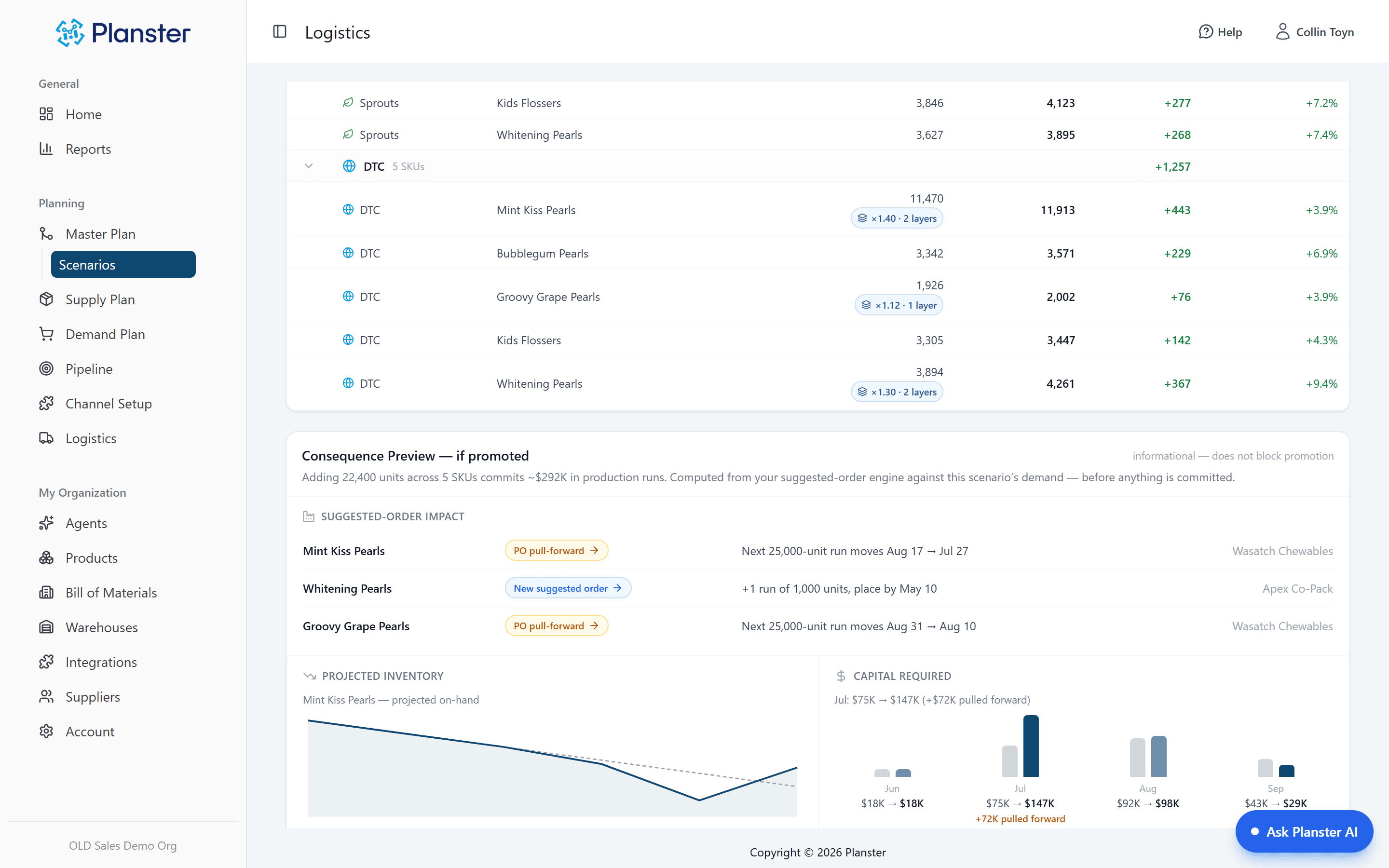
Planster's Master Plan runs every scenario through the same ordering calculation as your live plan and shows which POs move and how much cash the change pulls forward, before anyone approves it. Most planning tools tell you what to reorder; Planster also shows what a whole scenario commits.
Plan the retail launch, not just the reorder
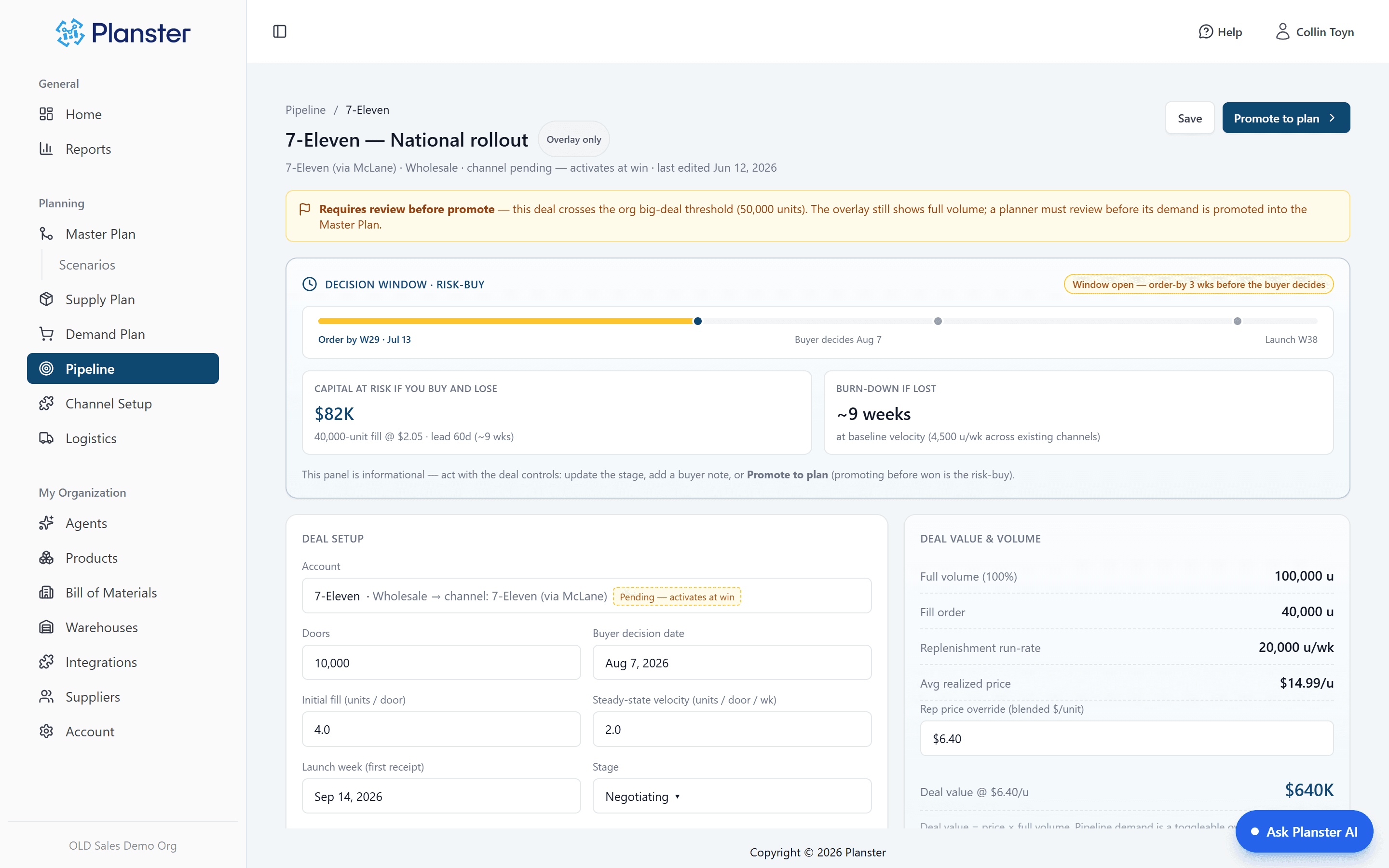
Planster's Pipeline puts retail deals into the demand plan at full volume and calculates the order-by date to make the launch and the cash at risk if the deal falls through. Whether to buy before the buyer decides is a question a reorder tool does not answer.
Checks run overnight; decisions stay with your team
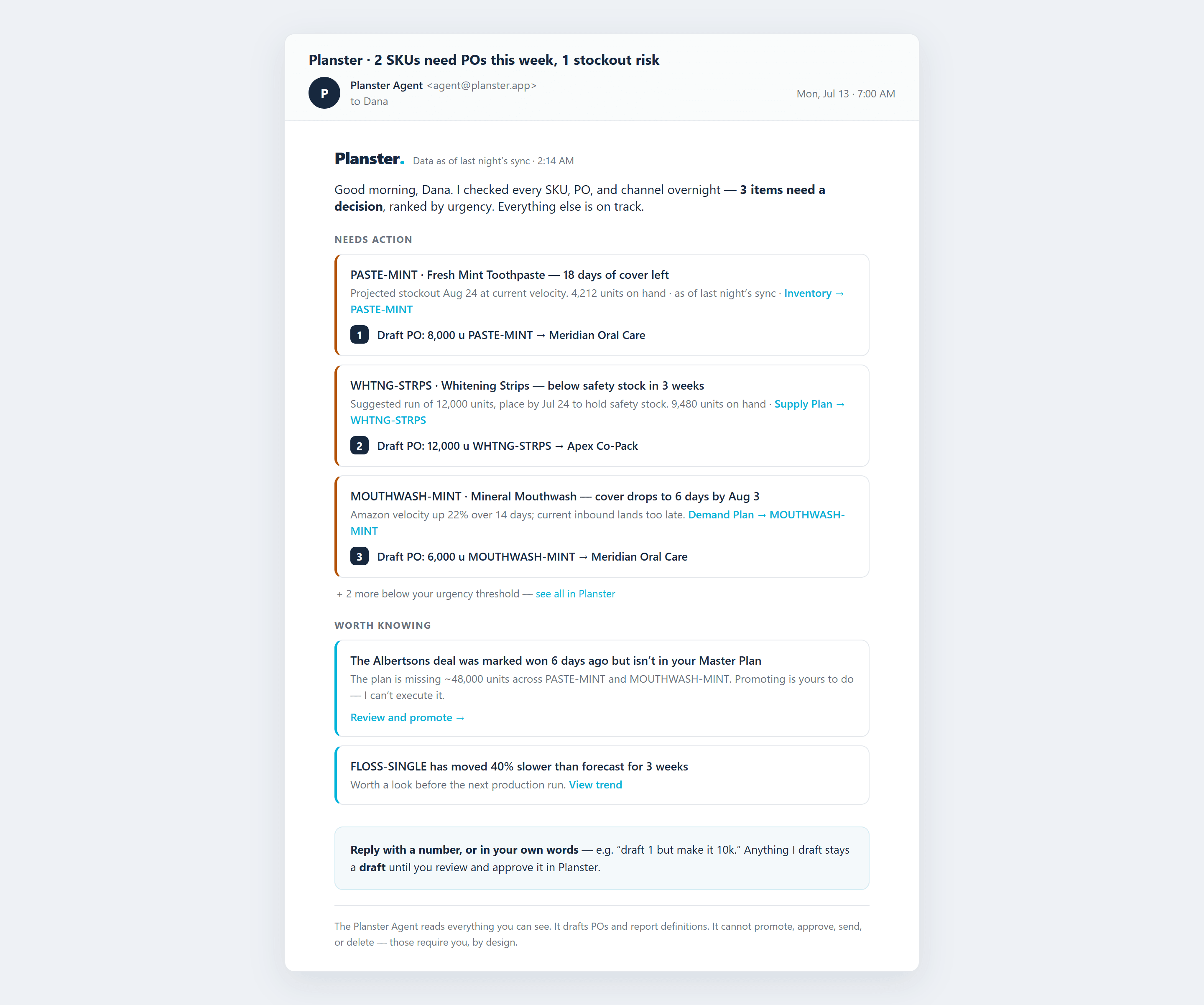
Every night Planster checks every SKU, PO and channel and emails a ranked morning digest with draft POs attached. Your team changes what it wants changed and approves in the app. It cannot approve a plan or an order, or send anything, on its own, and no setting changes that.
Pricing
Pilot $99/month, Plan $999/month, Produce $2,499/month, with unlimited users on every tier. Plan, the full app, is $999/month. All three prices are on the pricing page.
Katana's pricing page shows two plans. Free is "$0, no card required" for up to 30 SKUs, with unlimited users and all Katana features. Advantage is "Custom pricing" under one annual contract, with unlimited SKUs, users and integrations, an implementation manager, a Customer Success Manager and 24/7 live support (katanamrp.com/pricing, accessed 2026-11-03). This page does not estimate an Advantage price and does not claim Planster costs less. The two products do different jobs, so the useful comparison is what each one does for the money.
Katana pricing re-checked at katanamrp.com/pricing on 2026-11-03. Every other Katana fact on this page is sourced to katanamrp.com and support.katanamrp.com, accessed 2026-10-22, in marketing-brain/competitor-research/katana.md. Next review 2027-01-22.
When Katana is the better fit
No tool wins for everyone. Here's where Katana is the honest choice.
- You need a system of record, not a planning layer. Katana holds sales orders, purchase orders, manufacturing orders, outsourced purchase orders, recipes and BOMs, and stock by location and bin. Planster holds none of that as the record.
- You need batch and expiry tracking and traceability. Katana builds batch and expiry tracking in and traces finished goods back to ingredient batches for a recall. Planster tracks neither lots nor expiry dates.
- You run outsourced production as transactions. Katana's outsourced purchase orders move materials into a contractor's location and receive the finished goods back. Planster records purchase orders; it does not track materials sitting at a co-manufacturer.
- You have under 30 SKUs and want to pay nothing. Katana's Free plan is $0 with all features and unlimited users.
- You want an AI that writes into your records. Through Katana MCP, Claude or ChatGPT can create and update orders, products and BOMs. Planster's agent only drafts; a person approves every order in the app.
- You want implementation and support bundled. Katana's Advantage plan includes an implementation manager, a Customer Success Manager, 24/7 live support and regular inventory consultations.
- You want the replenishment forecast inside the same system as your orders. Katana's AI Replenishment turns its recommendation into a draft PO or manufacturing order in Katana's own approval flow.
Common questions
Is Katana an ERP?
Katana describes itself as cloud inventory and production management software for product businesses, and its homepage compares itself with legacy ERP (katanamrp.com, accessed 2026-10-22). In practice it is a system of record: it holds inventory, sales orders, purchase orders, manufacturing orders, outsourced purchase orders and BOMs. Planster is not that kind of system. It is planning software that decides what to order and when, and it is not an ERP or an MRP.
Does Katana forecast demand?
Yes. Katana's planning and forecasting feature projects demand for each product from sales history and current trends, and its AI Replenishment feature gives a 12-month forecast with seasonality, safety stock, a reorder point and minimum, recommended and maximum order quantities (katanamrp.com, accessed 2026-10-22). AI Replenishment runs on a selection of one SKU or up to 50 and needs at least six months of history. Katana does not name its model. Planster forecasts every SKU, with the model chosen per SKU from Prophet, ETS, SARIMA and linear regression.
How much does Katana cost?
Katana's pricing page shows a Free plan at $0 for up to 30 SKUs, and an Advantage plan on custom pricing under an annual contract (katanamrp.com/pricing, accessed 2026-11-03). Katana publishes no price for Advantage. Planster publishes three tiers: Pilot at $99/month, Plan at $999/month and Produce at $2,499/month, with unlimited users on every tier. To compare cost, request an Advantage quote and set it against those prices.
Does Planster integrate with Katana?
Not today. There is no Planster connector for Katana, and Katana is not in the Trackstar library Planster uses for warehouses and carts. A direct Katana connector is on Planster's roadmap and is not built. What a team can do now is connect Planster to the same carts and 3PLs Katana reads, such as Shopify, Amazon, ShipBob or ShipHero, or upload a file. Planster would then not see Katana's manufacturing orders, outsourced purchase orders or BOMs.
Does Planster replace Katana?
No. Katana is the record of what is in stock, what is on order and what is being made, including at a contract manufacturer, with batch and expiry tracking. Planster does none of that. Planster is the plan: one forecast across every channel, retail deals in it at full volume, scenarios that show what they commit before you approve them, and a ranked list of what to order. Many teams that make product need both kinds of software.
Does Katana have an AI agent?
Katana offers Katana MCP, which lets Claude or ChatGPT read, create and update inventory, orders, products and BOMs, with no delete, and Katana advises asking the AI to outline a change before confirming it (katanamrp.com/blog/katana-mcp, accessed 2026-10-22). It also offers AI Replenishment and an AI Assistant. Planster's agent sits on its own forecast and order calculation: every night it checks every SKU, purchase order and channel, sends a ranked morning digest, and leaves the purchase orders drafted in the app. It cannot approve an order or send anything to a supplier.
See what to order this week
Planster builds one forecast per SKU, shows what a scenario commits before you approve it, and ranks what to order, with the purchase orders drafted for your team.