Planster vs Iris Finance
Iris Finance calls itself an AI-native FP&A platform for consumer brands: a real-time P&L, a 13-week rolling cash forecast, margin by account after trade spend, and demand forecasting tied to those numbers. Planster is demand and supply planning software for $50–500M consumable CPG brands, manufacturers and co-manufacturers. It forecasts every SKU across retail, wholesale, DTC and Amazon, turns that forecast into a ranked list of what to order and when, and has the purchase orders drafted each morning. Iris tells finance what the inventory costs; Planster tells operations what to order.
Iris Finance details last reviewed
The short answer
No tool wins for everyone. Here's the honest split.
$50–500M consumable CPG brands, manufacturers and co-manufacturers whose operations team needs to know what to order, when and how much, with retail deals in the plan and purchase orders drafted every morning, at a published price.
Consumer brands whose finance team wants a P&L, a 13-week cash forecast, margin by account after trade spend and board-ready reporting in one place, with inventory forecasting tied to those numbers and CPG-experienced advisors alongside the software.
Feature-by-feature
| Capability | Planster | Iris Finance |
|---|---|---|
| What it is | Demand and supply planning software. The output is a decision: what to order, when and how much | An "AI-native financial planning and analysis (FP&A) platform" with four products: FP&A, business intelligence, advisory and supply chain (irisfinance.co, 2026-10-22) |
| Who it is written for | The operations team at a $50–500M consumable CPG brand, manufacturer or co-manufacturer: VP of operations, planners, purchasing | Finance leaders ("Business Intelligence Built for CPG Finance Leaders"). Product pages say "$1M–$50M+"; the homepage says "$5M to $500M+" (irisfinance.co, 2026-10-22) |
| Demand forecasting | One forecast per SKU, with the model chosen per SKU from Prophet, ETS, SARIMA and linear regression; seasonality detection and stockout periods excluded from the fit | "AI demand forecasting by SKU and channel", trained on the brand's own sales and adapting to seasonality and promotions, with daily plan vs actual (irisfinance.co, 2026-10-22) |
| Ordering | Every SKU's upcoming orders worked out from on-hand inventory, target levels, safety stock in days of cover and supplier lead times, ranked by due date, with MOQs and container quantities applied. POs placed and tracked through delivery | "Purchasing tied to real-time margin and cash flow" and "purchase order confidence + working capital optimization", with units on hand, sell-through and slow-mover flags (irisfinance.co, 2026-10-22) |
| Finance: P&L, cash forecast, valuation | Not an FP&A tool. No P&L, cash forecast or inventory valuation. Master Plan shows the cash a scenario commits to purchase orders, and nothing beyond that | Real-time P&L by channel, SKU and cohort; an automated 13-week rolling cash forecast; inventory valued by FIFO, weighted average or landed cost; variance analysis and board decks (irisfinance.co, 2026-10-22) |
| Margin by account after trade spend | Not offered | Nets trade spend against each account and SKU, ranks wholesale accounts by margin, and alerts when an account's margin turns negative (irisfinance.co, 2026-10-22) |
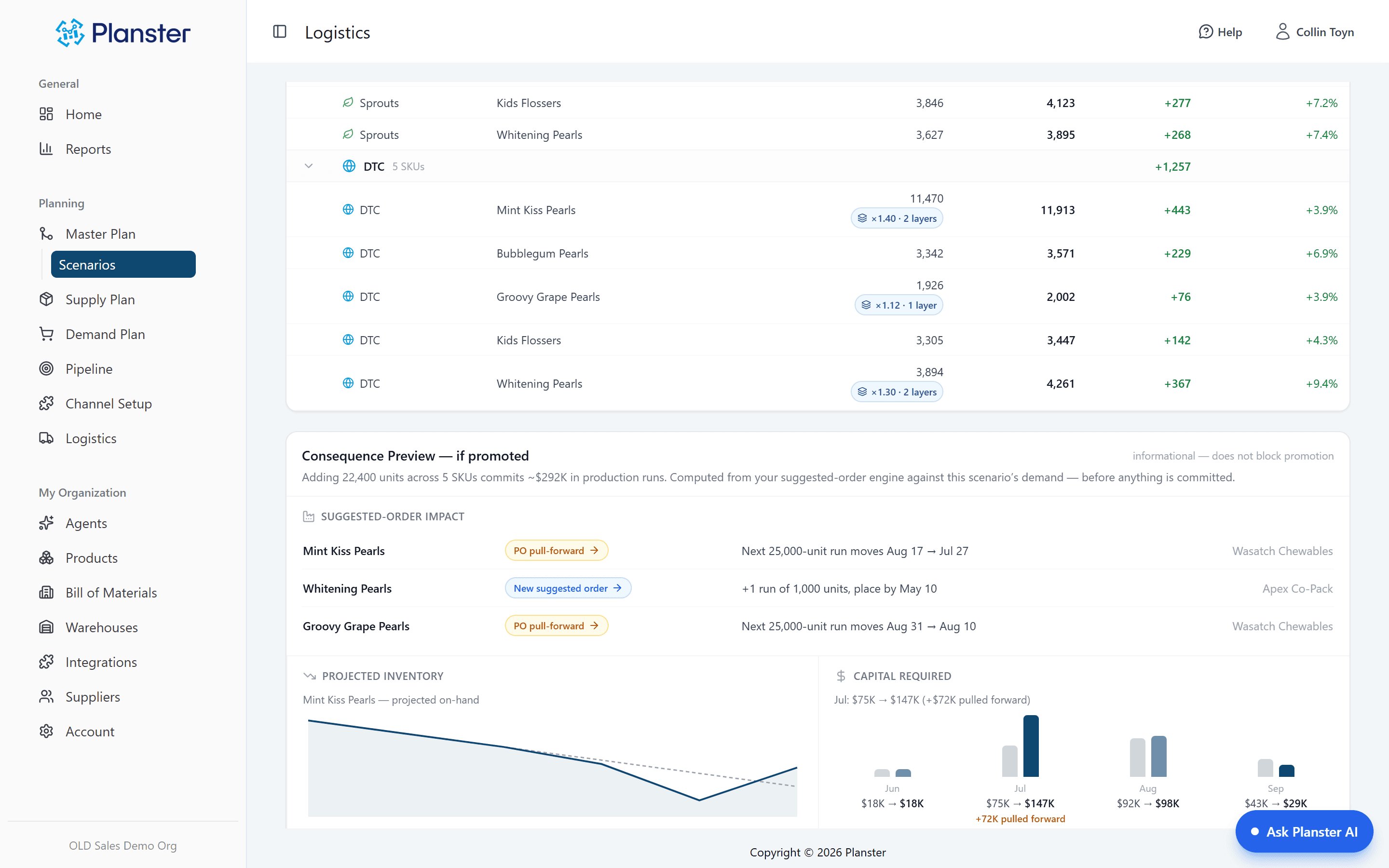
| Scenario planning | Scenarios sit on top of live demand and run through the same ordering calculation as the plan: which POs move and the cash committed (~$292K in the standard example). Approving one writes a version you can roll back | "Natural language scenario planning and modeling" and "scenario planning tied to cash flow" (irisfinance.co, 2026-10-22) |
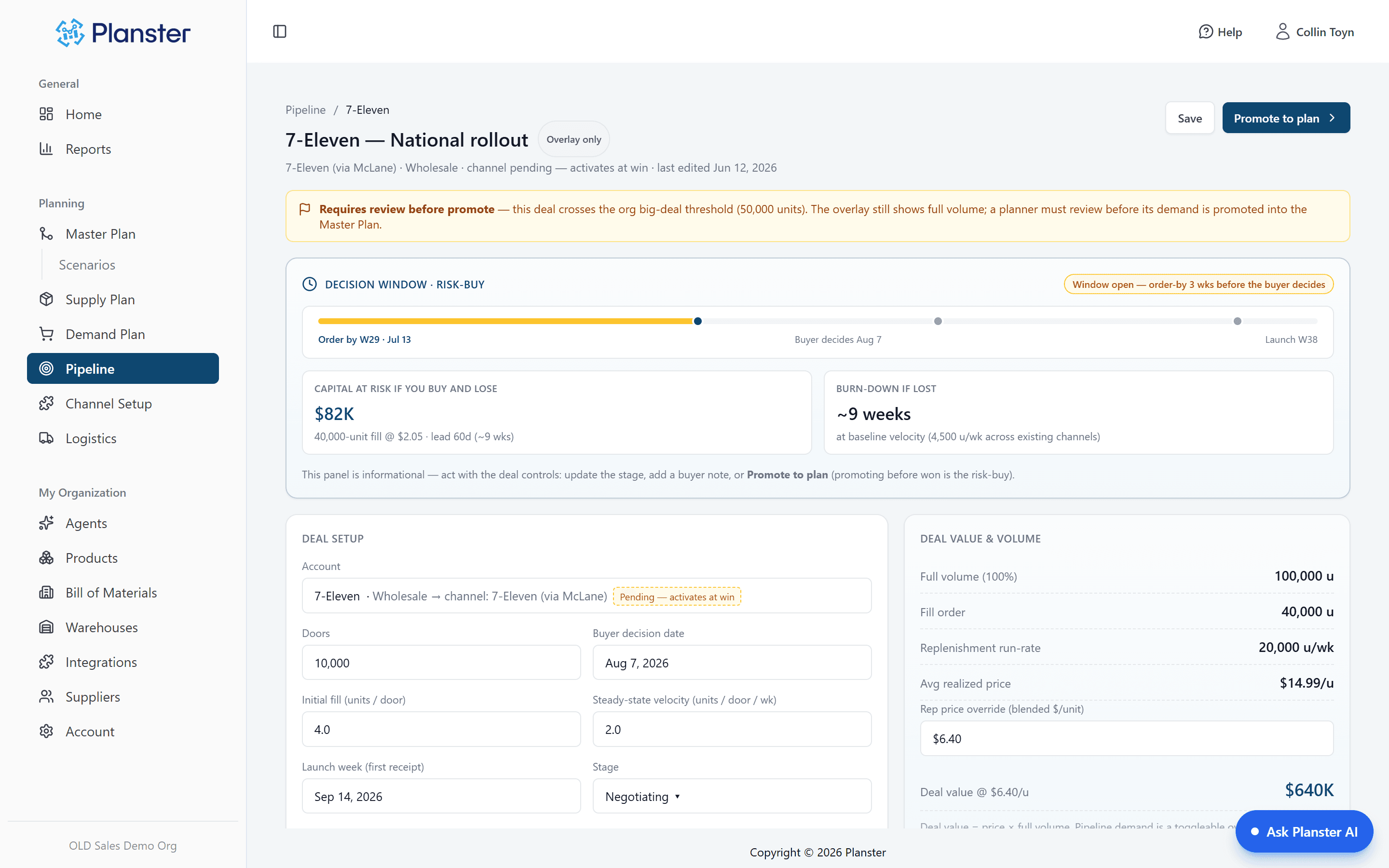
| Retail deals in the plan | Pipeline adds each retail deal to the plan at full volume, as the fill order, the gap after it and the replenishment run-rate, with an order-by date and the cash at risk if the deal falls through | Retail and wholesale appear as channels, and as accounts ranked by margin; doors and distributors ranked by contribution (irisfinance.co, 2026-10-22) |
| Warehouse and 3PL systems | 150+ through Trackstar, including 154 WMS, 3PL and fulfillment systems, read nightly | The integrations page names no WMS or 3PL by name (irisfinance.co/integrations, 2026-10-22) |
| Accounting, banking and ad platforms | No QuickBooks, Xero, Bill, banking or ad-platform connections today. The ERPs it reads are NetSuite, through Trackstar, and Sage 100, natively | Shopify, Amazon, QuickBooks, NetSuite, Xero, Meta, Google Ads, TikTok, Plaid and Bill, plus a read-only connector for Claude (irisfinance.co/integrations, 2026-10-22) |
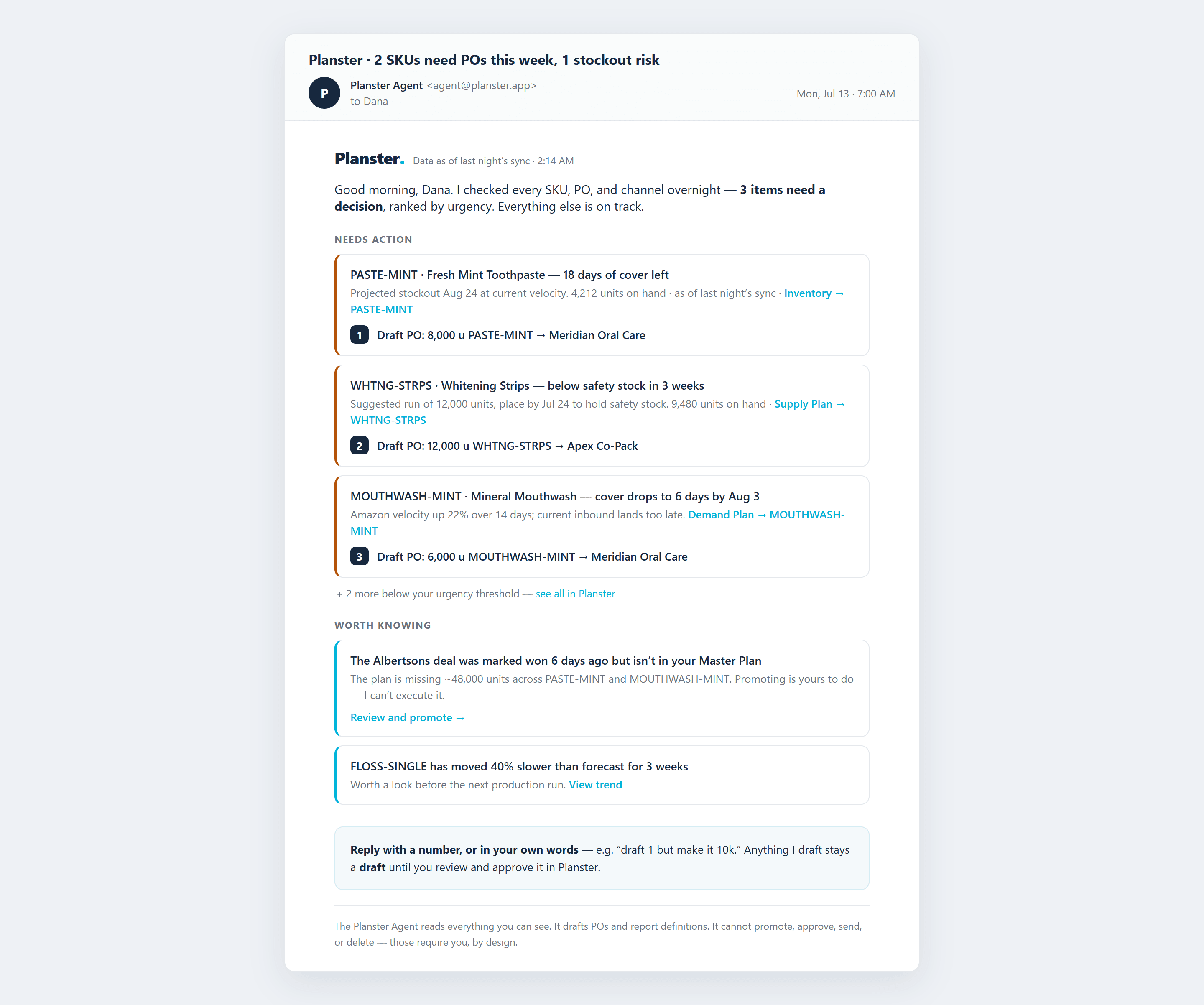
| AI | Built on the forecast and the order calculation: a nightly check of every SKU, PO and channel, a ranked morning digest, and the POs drafted in the app for your team to approve | An agent, "Fin", that answers questions in plain English, models scenarios and builds dashboards; board decks generated automatically (irisfinance.co, 2026-10-22) |
| Reporting | Custom only. Build any report you need, and the agent can draft the definition. There is no prebuilt report library | Dashboards and custom metrics built in plain English, plus automated board decks (irisfinance.co, 2026-10-22) |
| Services | Software | Agents plus "forward deployed teams", and an advisory practice of "CPG-experienced advisors and AI agents" (irisfinance.co, 2026-10-22) |
| Pricing | Pilot $99/month, Plan $999/month, Produce $2,499/month, published, with unlimited users | Not published. Pricing "is based on your brand's size and data sources", by quote (irisfinance.co/pricing, 2026-10-22) |
| How you start | A free agent on one integration or a file upload, with no call to book; Pilot at $99/month above it | Every primary call to action ("Get a Demo", "Prove it") goes to the sales-contact form (irisfinance.co, 2026-10-22) |
Where Planster pulls ahead
See what a decision costs before you commit
Planster's Master Plan runs every scenario through the same ordering calculation as your live plan and shows which POs move and how much cash the change pulls forward, before anyone approves it. Most planning tools tell you what to reorder; Planster also shows what a whole scenario commits.
Plan the retail launch, not just the reorder
Planster's Pipeline puts retail deals into the demand plan at full volume and calculates the order-by date to make the launch and the cash at risk if the deal falls through. Whether to buy before the buyer decides is a question a reorder tool does not answer.
Checks run overnight; decisions stay with your team
Every night Planster checks every SKU, PO and channel and emails a ranked morning digest with draft POs attached. Your team changes what it wants changed and approves in the app. It cannot approve a plan or an order, or send anything, on its own, and no setting changes that.
Pricing
Pilot $99/month, Plan $999/month, Produce $2,499/month, with unlimited users on every tier. Plan, the full app, is $999/month. All three prices are on the pricing page.
Iris publishes no price. Its pricing page says pricing "is based on your brand's size and data sources" and offers "a quote based on your use case"; the same page lists real-time P&L, cash flow forecasting and AI dashboards as included (irisfinance.co/pricing, 2026-10-22). This page does not estimate an Iris price and does not claim Planster costs less. What can be compared is the form: Planster publishes three prices, and Iris quotes.
Every Iris fact on this page is sourced to irisfinance.co, accessed 2026-10-22, in marketing-brain/competitor-research/iris-finance.md. Next review 2027-01-22.
When Iris Finance is the better fit
No tool wins for everyone. Here's where Iris Finance is the honest choice.
- Your question is profitability and cash. Iris gives finance a real-time P&L by channel, SKU and cohort, a 13-week rolling cash forecast, inventory valuation and board decks. Planster is not an FP&A tool and does none of that.
- You need margin by account after trade spend. Iris nets trade spend against each account and SKU and ranks wholesale accounts by margin. Planster has no trade-spend or account-profitability view.
- You want purchasing judged in cash terms. Iris ties purchasing to margin and cash flow, and on its food and beverage page ties production runs and co-packer terms to the 13-week cash forecast. Planster shows the cash a scenario commits, but it does not forecast cash.
- You want finance and planning in one finance-owned tool, connected to QuickBooks, Xero, Bill, Plaid and your Meta, Google and TikTok ad accounts. Planster connects none of those today.
- You want people as well as software. Iris pairs its agents with forward-deployed teams and offers advisory from CPG-experienced advisors. Planster sells software.
- You want dashboards built by asking for them in plain English. Iris does that; Planster's reporting is custom-only and has no prebuilt library.
- You need both. Some brands should run Iris for finance and Planster for orders, because the two answer different questions.
Common questions
Is Iris Finance an inventory planning tool?
Iris Finance describes itself as an AI-native financial planning and analysis (FP&A) platform for consumer brands, and supply chain is one of its four products alongside FP&A, business intelligence and advisory. The supply-chain product forecasts demand by SKU and channel, tracks units on hand, values inventory and ties purchasing to margin and cash flow, so it does plan inventory. It is written for finance leaders. Planster is planning software for the operations team, and its output is a ranked list of what to order and when.
How much does Iris Finance cost?
Iris Finance does not publish a price. Its pricing page says pricing is based on the brand's size and data sources and offers a quote based on the use case (irisfinance.co/pricing, accessed 2026-10-22). Planster publishes three tiers: Pilot at $99/month, Plan at $999/month and Produce at $2,499/month, with unlimited users on every tier. The only way to compare the two on cost is to request an Iris quote and set it against those published prices.
What size of brand is Iris Finance built for?
Iris Finance states two ranges. Its supply-chain and FP&A pages describe scaling brands from "$1M–$50M+", and its homepage describes "the finance stack that scales from $5M to $500M+" (irisfinance.co, accessed 2026-10-22). The industries it lists are beauty, vitamins and supplements, apparel, food and beverage, recreation and private equity. Planster is built for $50–500M consumable CPG brands, manufacturers and co-manufacturers in food, beverage, supplements, beauty and household goods.
Does Iris Finance have an AI agent?
Iris Finance has an agent called Fin that answers questions in plain English, models scenarios and builds dashboards, and Iris generates board decks automatically. It also offers a read-only connector that lets Claude query the financial model. Planster's agent sits on top of its forecast and order calculation: every night it checks every SKU, purchase order and channel, sends a ranked morning digest, and leaves the purchase orders drafted in the app for the team to approve.
Can you use Iris Finance and Planster together?
Nothing about the two products prevents running both, and for some brands it is the right answer: Iris Finance for the P&L, cash forecast and trade-spend margin, Planster for what to order and when. Both read Shopify, Amazon and NetSuite, with Planster reading NetSuite through Trackstar. No connector between Iris and Planster is published, so whether data should flow from one to the other is a question to put to both vendors.
See what to order this week
Connect the cart, the warehouse or NetSuite. Planster builds the forecast and ranks what to order, and the first list lands on day one.