Planster vs Excel
Excel is free, flexible, and where almost every CPG brand starts. It's also where forecasts go stale, formulas break silently, and one person becomes the single point of failure. Planster is purpose-built demand planning for $10–50M consumable CPG — automated, always current, and built so a plan is never one broken cell away from wrong.
The short answer
No tool wins for everyone. Here's the honest split.
CPG brands whose spreadsheet has become a part-time job, a single point of failure, or a source of costly stockouts and overstock — and who want automated forecasting, scenarios, and an agent instead.
Very early or very small brands with a handful of SKUs and one channel, where a spreadsheet is still fast enough and a wrong number costs little.
Feature-by-feature
| Capability | Planster | Excel |
|---|---|---|
| Data entry & refresh | Sales and inventory auto-sync via Trackstar (150+ systems); the plan is current every morning | Manual exports and copy-paste — stale the moment you finish building it |
| Forecasting | Auto-selected statistical models per SKU (Prophet/ETS/SARIMA), seasonality, dynamic safety stock | Whatever formulas you build and maintain by hand — usually a moving average |
| Holds up at scale | Unlimited SKUs, channels, and warehouses without slowing down or breaking | Formulas break, files bloat, and "final_v7.xlsx" versions multiply |
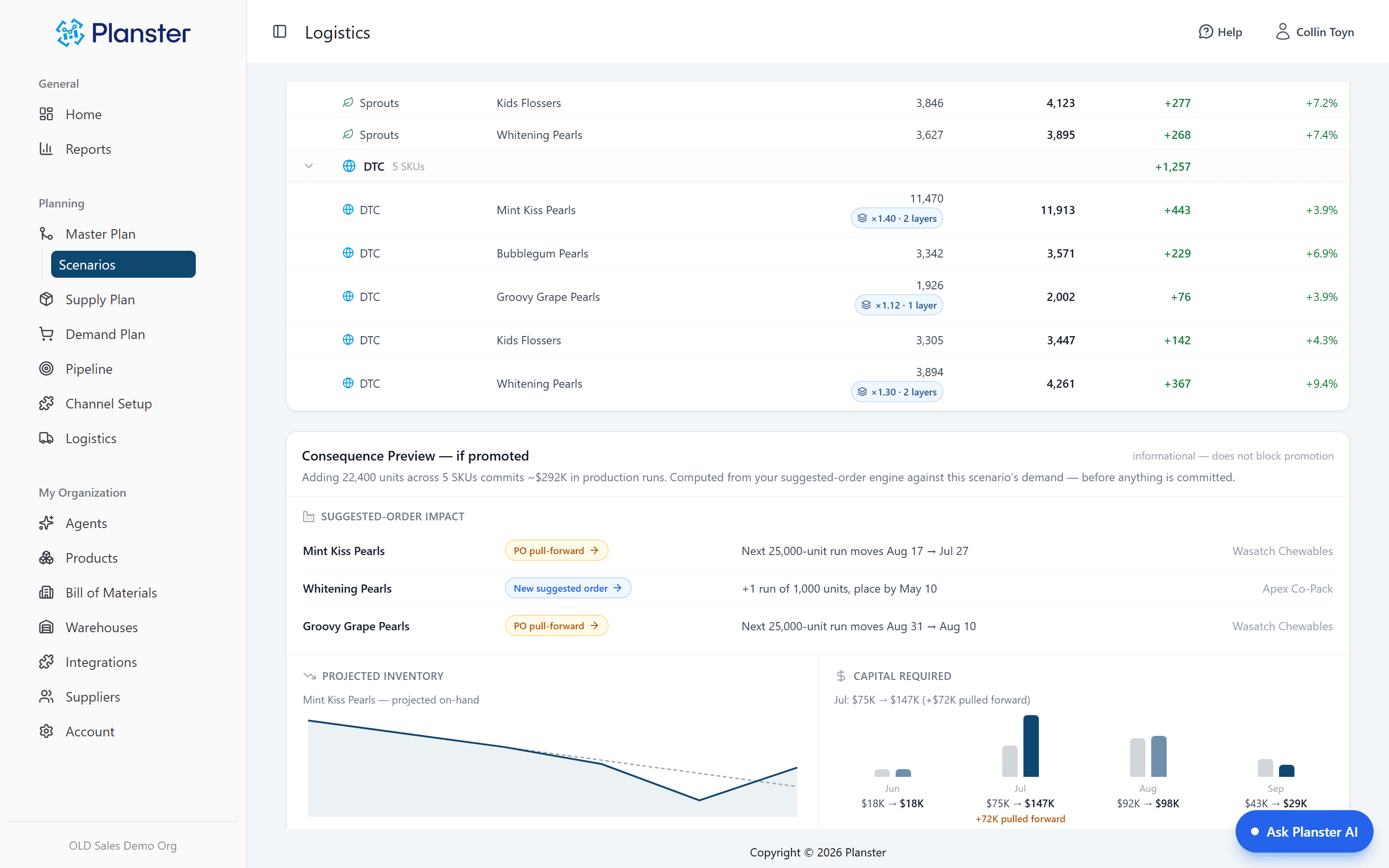
| Scenario planning with consequence preview | Sandbox what-ifs; see the capital a change commits (~$292K) before you promote it; un-promote to undo | A "Save As" copy that drifts stale, with no way to see what a change really commits |
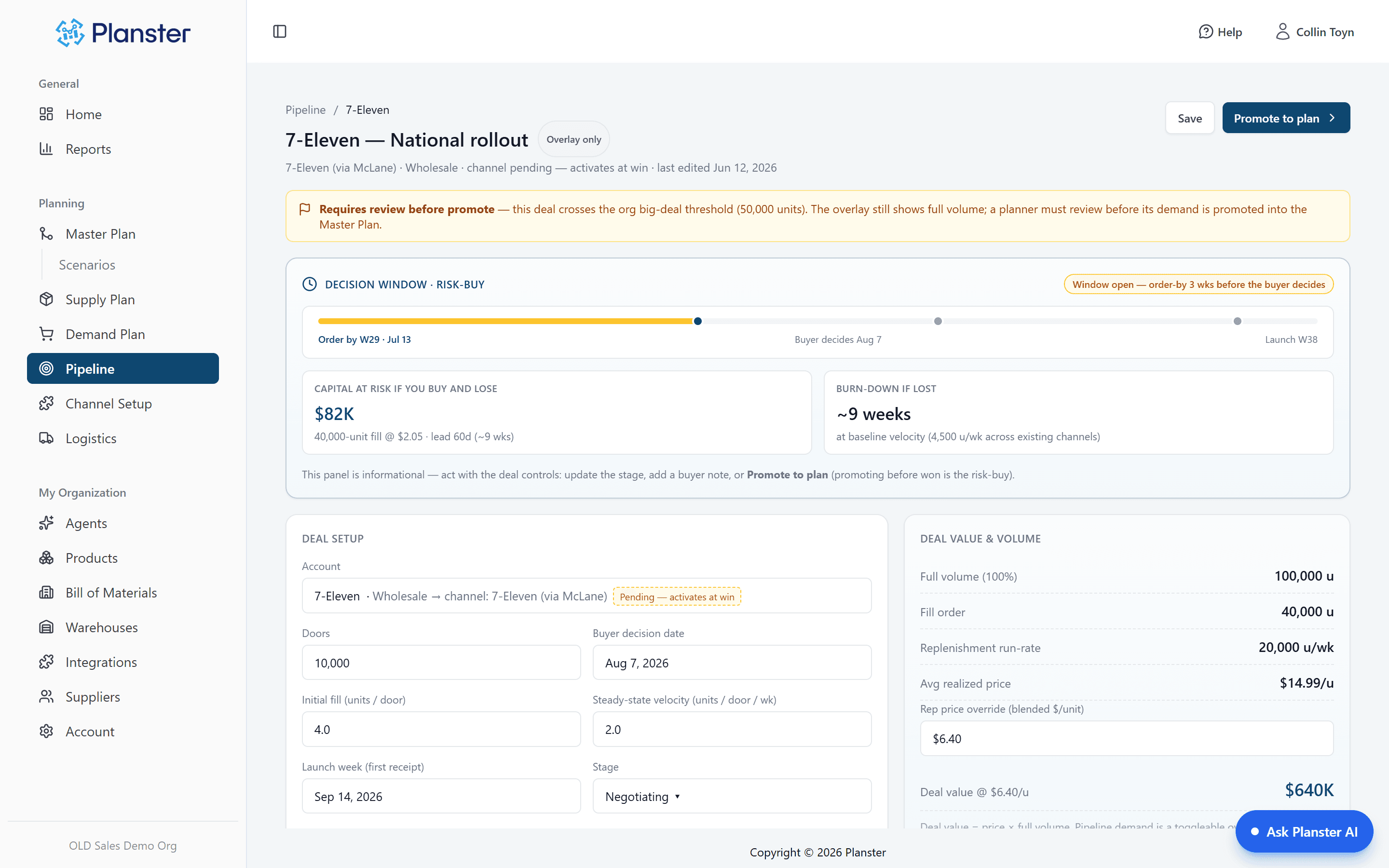
| Retail-deal pipeline → demand (risk-buy math) | Deals overlay the plan at full volume with order-by dates and capital-at-risk math | A separate tab someone forgets to update |
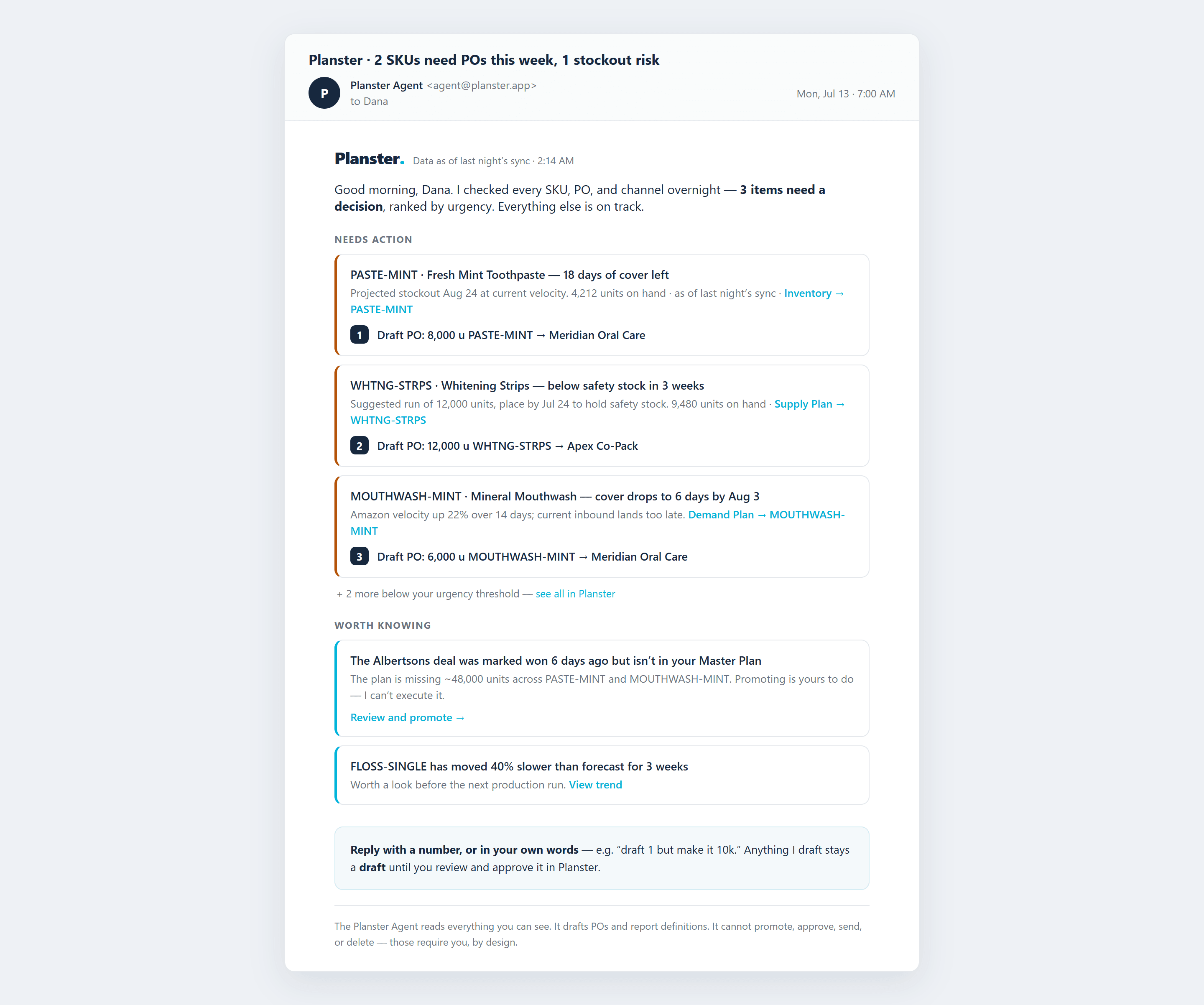
| AI agent | Overnight scan → ranked morning digest with draft POs; it tells you what changed | Can't tell you anything — you have to go find the problem yourself |
| Collaboration & key-person risk | Shared plan, no version conflicts, every change attributed | One person owns the file; if they're out, planning stops |
| Auditability | Every number links back to the screen and source behind it | A wrong formula can hide for months before anyone notices |
| Cost | Flat ~$1,000/mo | Free software — but paid for in hours, errors, and stockout/overstock risk |
Where Planster pulls ahead
See what a decision costs before you commit
Planster's Master Plan runs every what-if through your real ordering engine and shows the consequence — which POs move and how much capital the change pulls forward — before you say yes. Most planning tools tell you what to reorder; Planster tells you what a whole scenario commits.
Plan the retail launch, not just the reorder
Planster's Pipeline treats retail deals as living demand: a deal overlays your plan at full volume and does the risk-buy math — the order-by date to hit the launch, and the capital at risk if it falls through. That founder-level "do I buy before the buyer decides?" question is one a reorder tool never answers.
The checking happens overnight — the decision stays yours
Every night the Planster Agent checks every SKU, PO, and channel and emails a ranked morning digest with draft POs attached. You change what you want changed and approve in the app. It cannot promote, approve, or send on its own, and no setting changes that.
Pricing
Flat ~$1,000/month, everything included.
The spreadsheet is free. The real cost is the hours spent building and maintaining it, the stockouts and overstock that come from stale or broken formulas, and the risk of one person owning the entire plan. A single week of stockout on one product can run $5,000+ — more than half a year of Planster.
Cost framing from Planster's own ROI math (`app/pricing`) and the founding pitch.
When Excel is the better fit
No tool wins for everyone. Here's where Excel is the honest choice.
- You're very early or very small — a handful of SKUs, one channel — and a spreadsheet is still fast enough.
- Your planning stakes are low enough that a stale forecast or a broken formula won't cost real money.
- You need total ad-hoc flexibility for a one-off analysis that doesn't need to persist or sync.
Common questions
Isn't Excel free?
The software is — but planning in it isn't. The cost shows up as the hours spent rebuilding forecasts that are stale by the time they're done, and as the stockouts and overstock that come from stale or broken formulas. Avoiding a single week of stockout (often $5,000+) more than covers a year of Planster.
Can I bring my existing spreadsheet data into Planster?
Yes — Planster supports data import, and it connects directly to your sales and inventory systems via Trackstar, so you stop maintaining the numbers by hand. Most brands are up and running in days and surface a real problem within minutes of connecting their data.
Your spreadsheet got you here. It won't get you there.
See automated, always-current demand planning. Most brands find real stockout risk on day one.