Planster vs DOSS
DOSS is an operations cloud with ten modules, sold to consumer brands from $20 million to $250 million, and most clients are live within four to six months. Planster is one product for $50–500M consumable CPG brands and manufacturers: it plans alongside the ERP you already run — NetSuite through Trackstar, Sage 100 natively — or reads the cart, the warehouse and the marketplaces directly, builds one forecast per SKU, and tells you what to buy and when. The real question is whether you need a new system of record, or a planning layer on top of the one you have.
The short answer
No tool wins for everyone. Here's the honest split.
$50–500M consumable CPG brands and manufacturers that already have an ERP — or a cart, a 3PL and a spreadsheet — and want the buying decision — forecast, reorder point, order-by date, drafted PO — without replacing the systems underneath first.
Consumer brands from $20M upward that need one system of record for procurement, finance, warehouse, fulfillment and planning together, and can give a replacement four to six months.
Feature-by-feature
| Capability | Planster | DOSS |
|---|---|---|
| What you are actually buying | Planning as the whole product — forecast, reorder, scenarios, retail deals, overnight agent | An operations cloud of ten modules — inventory, procurement, order management, finance, freight, warehouse, demand planning, production, projects, relationships. Demand planning is one of them |
| Who it is sold to | $50–500M consumable CPG — brands, manufacturers and co-manufacturers in food, beverage, supplements, beauty, household | "$20 million to $250 million in annual revenue", mid-market consumer brands (TechCrunch, 2026-03-24) |
| Time to first plan | Days. Sales and inventory sync through Trackstar, and the first ranked list of what to order lands on day one | "Most clients are live within 4-6 months" (doss.com, 2026-08-11) |
| Forecasting method, published | Named and auto-selected per SKU: Prophet, ETS, SARIMA, linear regression, re-tested as the pattern changes | Not published. The site names "forecasting tools" and "campaign modeling"; no model, service level or safety-stock method appears anywhere, and there is no demand-planning page (checked 2026-08-11) |
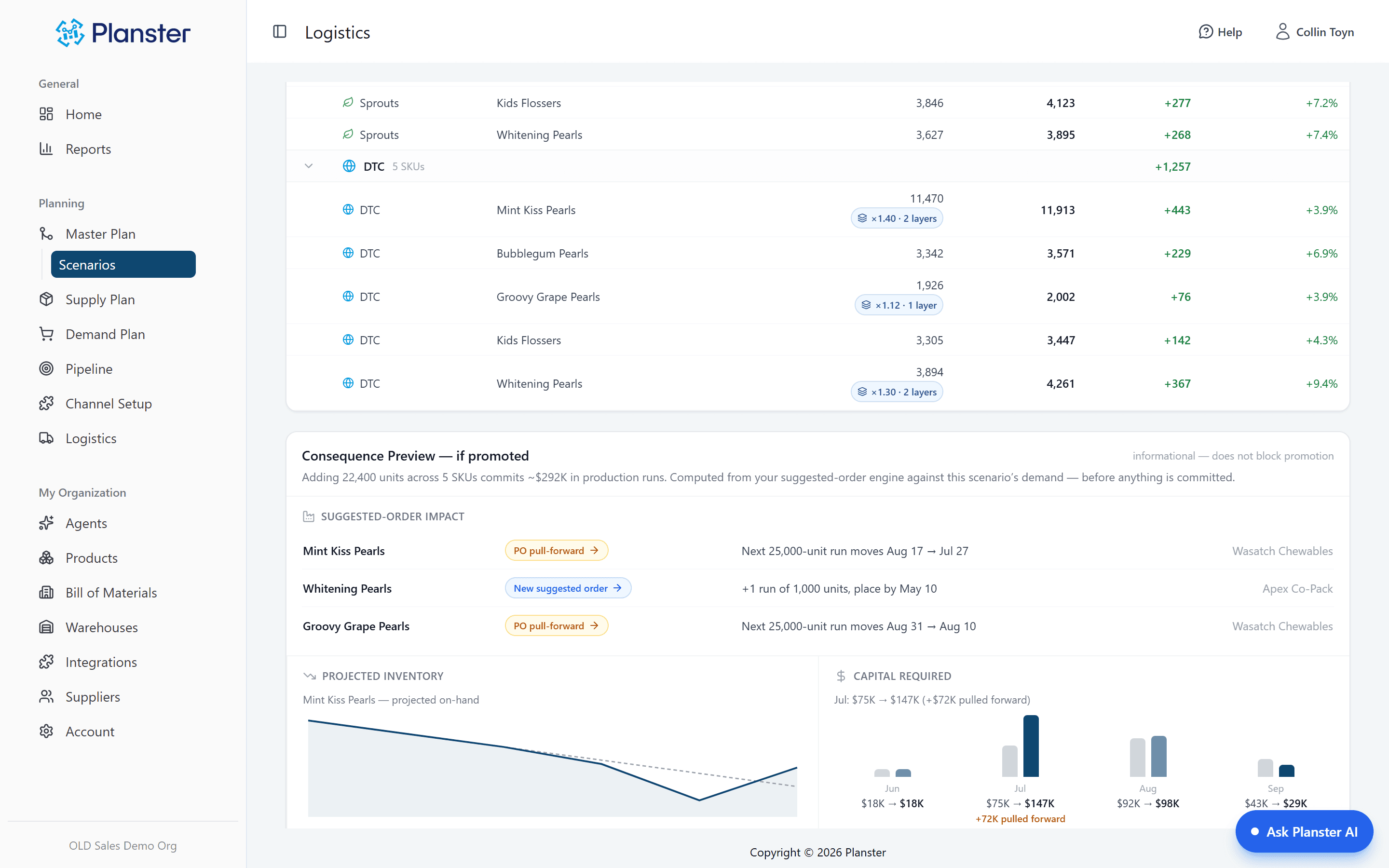
| Scenario planning with a cost preview | Master Plan runs a scenario through the same ordering calculation as the live plan: which POs move, and the cash it commits (~$292K) before you approve it. Rolling back restores the prior version | We could not find a scenario planner or capital preview published. "Campaign modeling" is the nearest named feature and is not the same thing (checked 2026-08-11) |
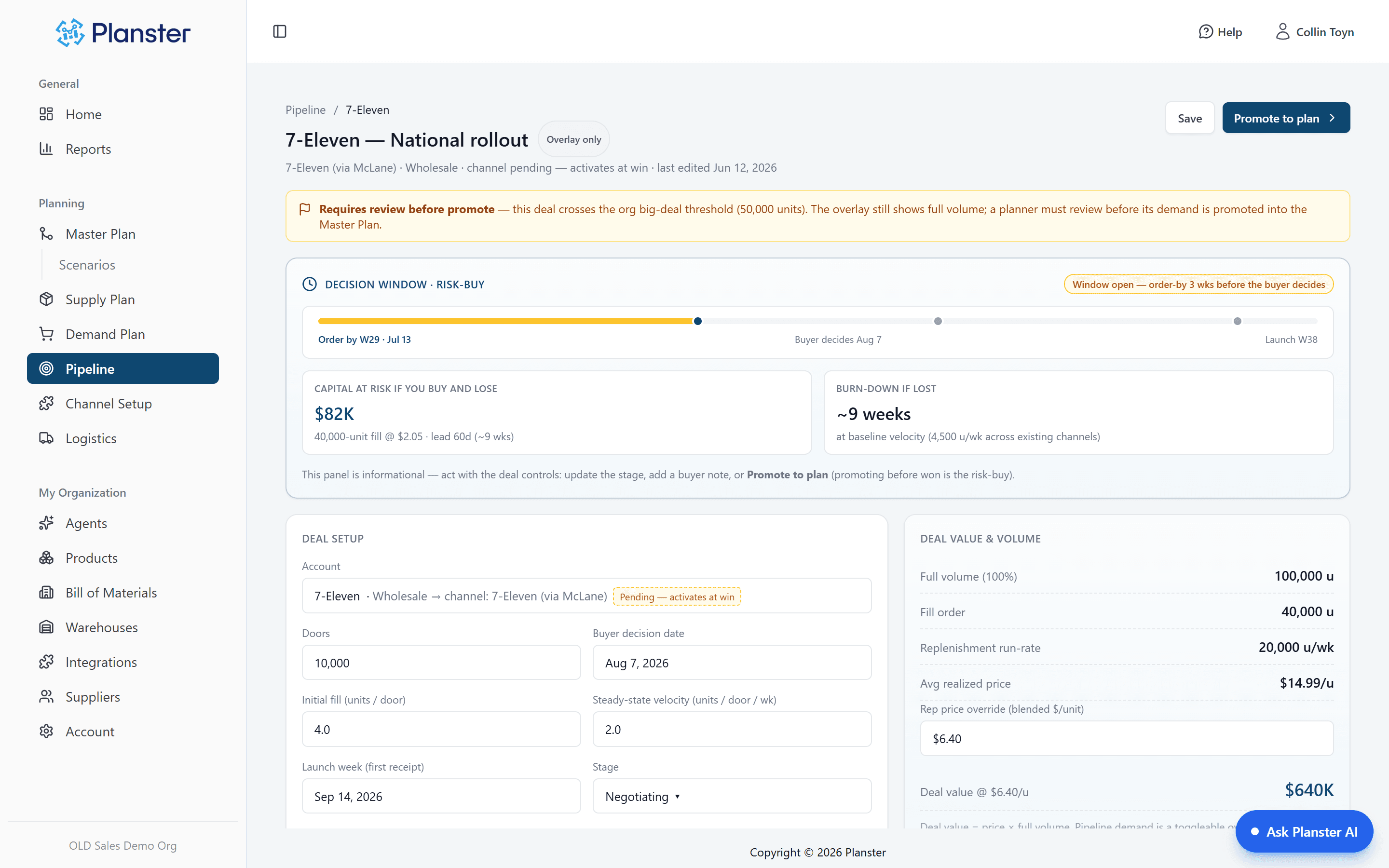
| Retail deals feeding demand | Pipeline overlays a deal on the plan at full volume, with the order-by date and the cash at risk if it falls through | Relationship Management is one of the ten modules. We could not find anything published that connects a deal to a supply plan (checked 2026-08-11) |
| Integrations | 150+ through Trackstar — 154 WMS/3PL and 17 cart/marketplace. Sage 100, Zoho Analytics and Luminous native; NetSuite through Trackstar; QuickBooks Online and Xero rolling out | Integrations named publicly: Rillet, Campfire and Intuit QuickBooks (TechCrunch, 2026-03-24) |
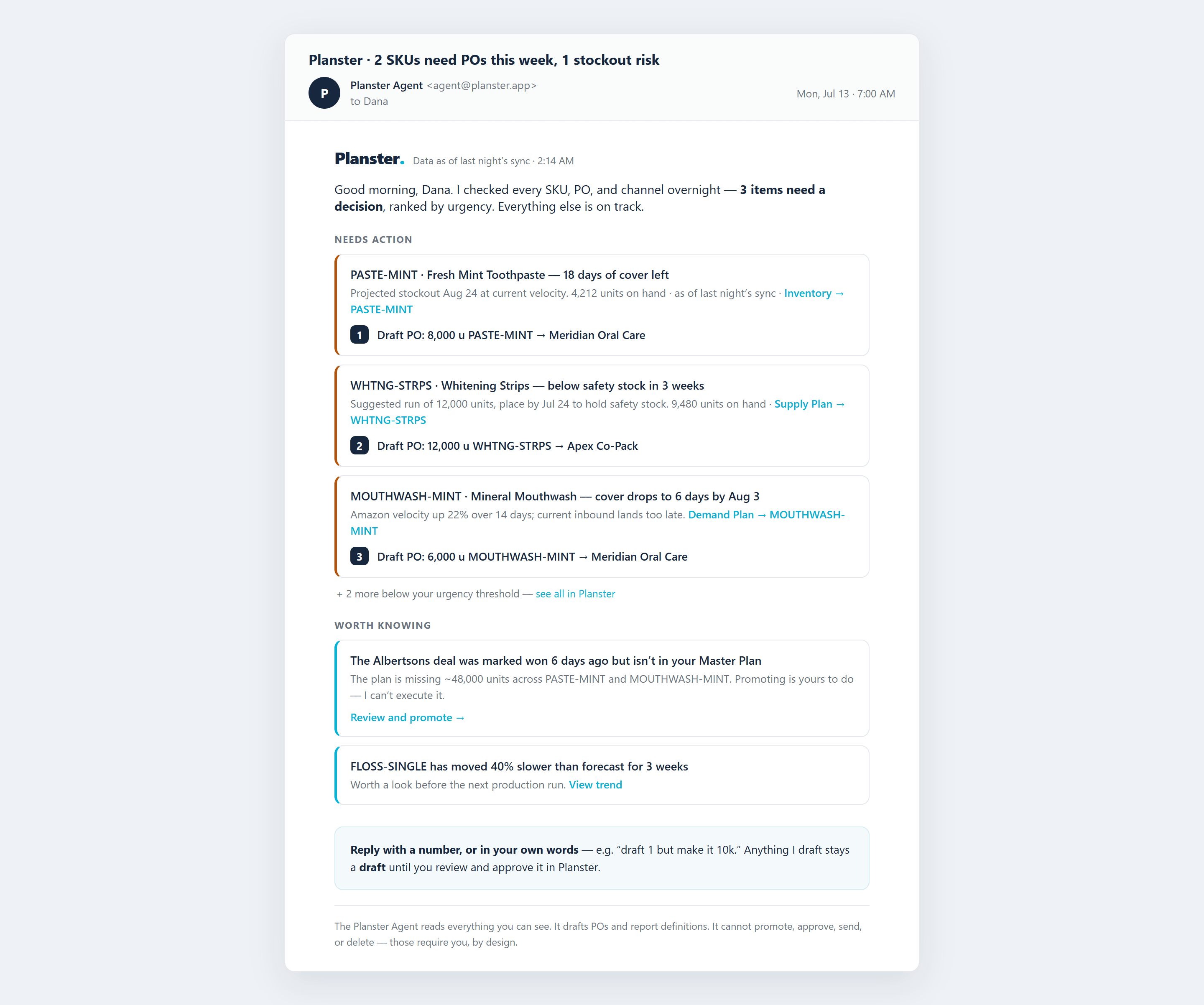
| AI | Overnight run across every SKU, PO and channel; ranked morning digest with the POs already drafted in the app. It cannot approve a plan or an order, or send anything, and no setting changes that | Dossbot, a chat-driven copilot for building reports, fixing data errors and bulk changes, plus "AI-generated POs & invoices". Whether there is a human approval gate is not published |
| Reporting | Custom only — build any report you need, and the agent can draft the definition. There is no prebuilt report library | DataStudio, a named BI layer, plus report building through Dossbot (doss.com and TechCrunch, 2026-08-11) |
| Pricing | Plan $999/month for the full app; three tiers published on the site | Quote-only, no tiers or amounts published. No separate implementation fee, and no billing until you go live (doss.com/pricing, 2026-08-11) |
| Money behind the company | Bootstrapped and angel-funded | $73M raised, most recently a $55M Series B co-led by Madrona and Premji Invest (TechCrunch, 2026-03-24) |
Where Planster pulls ahead
See what a decision costs before you commit
Planster's Master Plan runs every scenario through the same ordering calculation as your live plan and shows which POs move and how much cash the change pulls forward, before anyone approves it. Most planning tools tell you what to reorder; Planster also shows what a whole scenario commits.
Plan the retail launch, not just the reorder
Planster's Pipeline puts retail deals into the demand plan at full volume and calculates the order-by date to make the launch and the cash at risk if the deal falls through. Whether to buy before the buyer decides is a question a reorder tool does not answer.
Checks run overnight; decisions stay with your team
Every night Planster checks every SKU, PO and channel and emails a ranked morning digest with draft POs attached. Your team changes what it wants changed and approves in the app. It cannot approve a plan or an order, or send anything, on its own, and no setting changes that.
Pricing
Pilot $99/month, Plan $999/month, Produce $2,499/month — unlimited users, SKUs, warehouses and integrations on Plan and Produce. Published, and priced by what you plan rather than by your sales.
Quote-only. DOSS publishes no tiers and no amounts, describing it as "a single recurring fee for access to the platform, applications, and ongoing support". Two of their terms are better than most of this category, ours included, and are worth naming plainly: there is no separate implementation fee, and you do not pay until you go live — "so you can back out anytime if your needs aren't being met" (doss.com/pricing, 2026-08-11).
DOSS does not publish a price, so this page does not estimate one. Every DOSS fact here is sourced in marketing-brain/competitor-research/doss.md, verified 2026-08-11, next review 2026-11-11.
When DOSS is the better fit
No tool wins for everyone. Here's where DOSS is the honest choice.
- You need a system of record, not a planning layer. If the business runs on spreadsheets and disconnected portals and you are ready to replace that foundation, DOSS does that and Planster does not.
- You want procurement, finance, warehouse and fulfillment in the same system as planning. That is nine modules Planster has no answer to.
- You are under $50M. DOSS sells from $20 million a year in revenue; Planster is built for $50 million and up, so below that line DOSS is the one designed for your size.
- You would rather not pay until you are live. DOSS charges no separate implementation fee and does not bill until go-live, which is a better commercial posture than most of this category.
- You want the best-funded vendor in the lane. DOSS has raised $73M; Planster has not, and if that matters to your procurement process it is a real answer.
Common questions
Is DOSS an ERP?
DOSS describes itself in two ways that are worth reading side by side. The site calls DOSS Operations Cloud "the ERP evolved" and "the ERP alternative built for Consumer brands", while the founder told TechCrunch in March 2026 that Doss "does not replace ERPs — it plugs into existing systems" and that they "would rather partner with them, and play a different game". Both are DOSS's own words. What is not in dispute is the shape of the product: ten modules spanning inventory, procurement, order management, finance, freight, warehouse, demand planning, production, projects and relationships — with demand planning as one of them.
How long does DOSS take to implement?
DOSS states on its consumer-goods page that "most clients are live within 4-6 months". That is inherent to putting in a system of record rather than a failing of theirs — anything that becomes the place your finance and warehouse data lives takes that long. Planster is usually running in days, because nothing is being replaced: sales and inventory sync through Trackstar and the first ranked list of what to order arrives on day one. If you are mid-season and this quarter's plan is already wrong, that gap is the whole decision.
What forecasting method does DOSS use?
DOSS does not publish one. The consumer-goods page describes "forecasting tools", "campaign modeling" and predicting "sales patterns across channels, seasons, regions, and product variants", but names no model, no service-level target and no safety-stock method, and there is no dedicated demand-planning page on the site (checked 2026-08-11). That is a documented difference in what each company discloses, not a claim about what their software can do. Planster publishes its method: Prophet, ETS, SARIMA and linear regression, tested against each SKU's own history and re-selected when the pattern changes.
Is Planster cheaper than DOSS?
Nobody outside DOSS can answer that, because DOSS prices by quote and publishes no tiers or amounts. Planster publishes its tiers on the pricing page — Pilot $99/month, Plan $999/month, Produce $2,499/month — and they are priced by what you plan, not by your sales. What can be compared is the commercial shape. DOSS charges no separate implementation fee and does not bill until you go live, which is genuinely good and better than most of this category. Planster asks you to weigh one published number against a quote you have to request.
Can you use Planster and DOSS together?
Nothing about the two products prevents it, and the founder of DOSS describes their platform as plugging into existing systems rather than replacing them. Planster reads sales and inventory through Trackstar, which covers 154 WMS/3PL and 17 cart and marketplace systems, plus native connectors for Sage 100, Zoho Analytics and Luminous. Whether your particular DOSS deployment can feed Planster is a question for both vendors, and it is not something this page can verify — no DOSS-to-Trackstar connector is published either way.
Add planning without replacing your systems
Connect the cart and the warehouse. The first ranked list of what to buy lands on day one, and nothing reaches a supplier until you approve it.